

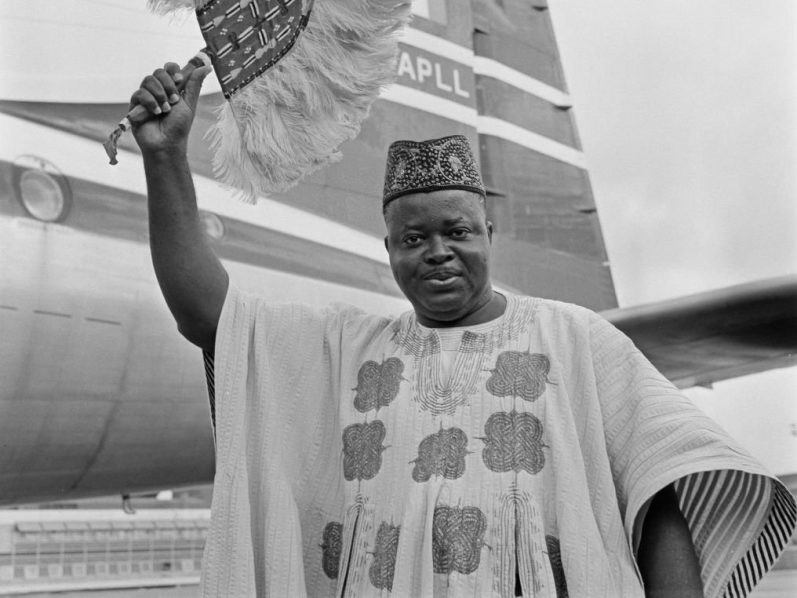
No one conversant with the history of Nigeria in the I950s and 1960’s will miss the overwhelming impact of Dr M.I. Okpara on the nation. After all by 1964 he was fully in charge of the fastest growing and industrialising economy in the world- the Eastern Nigerian economy. Nothing illustrates the warped sense of history and the complete abandonment of the values of merit and excellence in our national affairs as this wilful omission. The period of Okpara’s stewardship of Eastern Nigeria is truly the golden age of Nigerian development.
As I pointed out in a public lecture in 1995, by 1964- five years after Okpara’s ascendancy to the premiership- Eastern Nigeria as recorded by a research group in Michigan State University in the US, Eastern Nigeria was the fastest growing and industrialising economy in the world – ahead of Malaysia, Korea, Taiwan and Singapore.
How did this happen?
It was the culmination of Okpara’s unique vision in which agriculture and industrial development were the twin pillars on which he built the Eastern Nigerian economy. In agriculture his plans had a two-fold thrust- the development of the farm settlements as the anchor for food crop (such as rice) and poultry development, as well as the establishment of estates of oil palm, cocoa, cashew etc which were processed for export. Alongside the agricultural projects, were numerous industrial projects scattered over the length and breadth of Eastern Nigeria.
In one frenetic burst of energy, a wave of maniacal and frenzied activity was on-going all over Eastern Nigeria. As the book reminds us “ by January 25, 1963, the Michelin Factory at Port Harcourt was opened. The tyre factory was a USD 3,000,000 undertaking. On March 22, the headquarters building of the Universal Insurance Company was opened in Enugu. On May 10 the Nigeria Gas factory was commissioned at Emene near Enugu. On May 16, the Aluminium Factory at Port Harcourt was opened. On August 24, the Glass factory became operative in Port Harcourt. On October 18, the Asbestos Cement Factory was opened in Emene. On November 9, the foundation of the Central Bank was laid in Port Harcourt. On November 30, the Golden Guinea Breweries was commissioned at Umuahia, for the production of larger beer and allied products. On December 13 Hotel Presidential was opened at a whopping cost of BPS £2,000,000.
The burning fire for industrialisation led to the establishment of the modern ceramic industry in Umuahia, textile mills at Aba and Onitsha and a shoe factory in Owerri. There was a catalogue of numerous small industries that were also established simultaneously with the major ones during this period. It was during this period that the first phase of the farm settlements scheme were established – Ulonna in Umuahia province, Ohaji in Owerri Province- Igbariam in Onitsha province, Boki in Ogoja province, Uzo Uwanni in Enugu province, Abak in Annang province. Each was to accommodate over 5,000 farmers and what was remarkable was the scrupulous effort for even spread of the settlements throughout the length and breadth of the region.
All these activities had been elaborated in his vision for the development of the region after the general elections of 1961. As he stated…”the period immediately following the elections was a period for building the economic consciousness of the people”
It is this consciousness and burning desire to raise the standard of living of our people, the unflinching determination to assault poverty from all fronts, that has been distilled into the 1962-68 development plan. Inviting the people as citizens of a democratic region to examine, approve, criticise or condemn any portion of the plan (the plan is the peoples plan) it provides for the development of the small village, it touches on the requirements of the largest city; it caters for the need of the smallest peasant industry and prescribes the means for the mounting of the biggest industries…”
What was remarkable in his vision was the appreciation of the role of the private sector. As he observed to achieve rapid economic growth and raise the standard of living of the people, it was necessary that “the private citizens, the ordinary men and women everywhere must participate by taking a fair and equitable share in our development and industrial projects…”
He elaborates on this vision when he states
“…..In encouraging and participating in the industries established in the Region, our government was doing so on behalf of the citizens of the Region. It was, as it were, holding its shares on trust for the people. As and when the industries have overcome their teething problems and the risk of failures minimized, government proposes to divest itself of most of its shares and the money realized used in pioneering into new industrial projects…” Thus, the visionary did not only recognise the role of the government as the steward on behalf of the people but more importantly acknowledged the government’s fiduciary responsibility.
It was an incredible display of courage in the midst of rampaging risk factors and the energy to pursue longterm goals on behalf of the people. It was a remarkable demonstration of transparency and accountability. It was a vision that was forty years ahead of its time. These latter values were illustrated by his commitment to participatory democracy as shown in the fact that he inaugurated an annual series of leaders of thought conferences (a total of five in 1960, 1962, 1963 and 1965).
A remarkable aspect of his industrialisation plan was the collaboration and cooperation with foreign investors to undertake the large industries such as Michelin Tyre factory in Port Harcourt and the Nkalagu Cement factory in present day Ebonyi state. Indeed in Okpara’s long term vision as he told me in a conversation in his home in Nkwoegwu in 1983 was that Port Hacourt through Aba and Umuahia going on to Enugu would have developed into a globally significant industrial megapolis and conurbation.
This drove his passion for the development of the University of Nigeria for which he has not, in my view, been given adequate credit. He provided the money through his prudent management of the resources of the region. If the politics of those times had been better managed, Eastern Nigeria would have been ahead of South Korea, Taiwan and Singapore for we were indeed ahead of these success stories of the second half of the 20th century. What was most remarkable was his spirit characterised by his disarming humility and rock-solid determination to confront all the odds frontally. These were exemplified by his return to medical school after the war!
We cannot end this without recognising the unique strategies he adopted for the management of the government and the instruments he adopted for his far reaching economic programmes. For the latter, the Eastern Nigeria Development Corporation was the engine room for the pursuit of his economic development plans. His management of men and resources was imaginative, innovative and revolutionary. The most remarkable attribute is that after his stint as Premier of Eastern Nigeria he returned to live in his father’s modest bungalow even as some members of his cabinet had vast estates in their hometown and elsewhere. That speaks volumes of his integrity.
He had arrow heads who coordinated the activities of the government in addition to the informal agencies of democratic participation. He ceded the day to day running of the party to his old friend Dr L C Mbanugo, the civil service to Sam Oti, the intelligentsia to Professor Kalu Ezera and the economic domain to Odumegwu Ojukwu Snr. These were his kitchen cabinet at it were and beyond the formal structures of the party and the bureaucracy. Thus, he could exercise an inspiring overview to the business of governance through the formal structures of governance, even as he recognised the validity of the informal networks that are the eyes and could invigorate governance.
In the final analysis his success ultimately rested on his understanding of his people and the operative environment that had shaped him and his people. He certainly deserves intense study if we are ever going to appreciate where the rain started to beat us given our present circumstances. The book is an honest effort but is riddled with avoidable typographical and other errors but it is a treasure trove of information on the Okpara years and a wistful reminder of what Nigeria could have been. Nevertheless, the vision must survive and endure.
By Professor Anya O Anya, PhD (Cambridge) D.Sc (Hon) FAS, OFR, NNOM
Abuja 26 February 2014
Disclaimer:
The opinions and views expressed in this write-up are entirely those of the Writer(s). They do not reflect the opinions and views of the Publisher (Nze Ikay Media) or any of its employees. The designations employed in this publication and the presentation of materials herein do not imply the expression of any opinion whatsoever of the Publisher (Nze Ikay Media) or its employees concerning the legal status of any country, its authority, area, or territory or concerning the delimitation of its frontiers. Equally, the sketches, images, pictures, and videos are obtained from the public domain.