

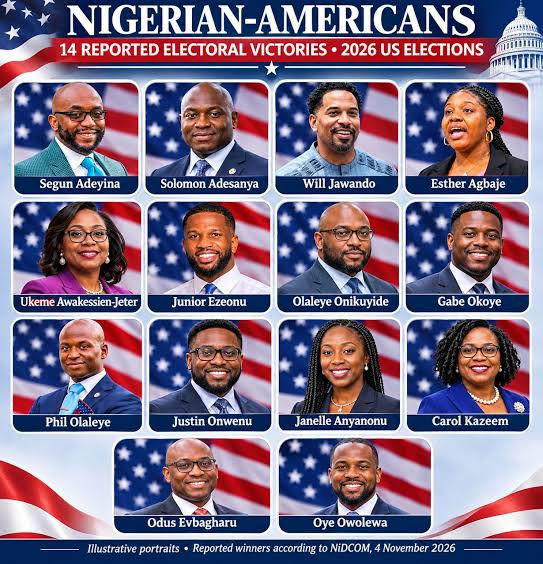
On the night of November 3, 2026, as the blue wave swept across the United States and Democrats reclaimed both chambers of Congress, another quieter tide was rising—one that few cable news panels bothered to chart. From the county offices of Maryland to the statehouse chambers of Georgia, from a Texas suburb to the Council of the District of Columbia, fourteen Nigerian-born American citizens won their elections, all under the Democratic Party umbrella. The Nigerians in Diaspora Commission (NIDCOM) hailed the results as a milestone, noting that these victories spanned county administration, state legislatures, and local governance, and that they reflected the growing contributions of Nigerians and people of Nigerian descent to public leadership in the United States. Yet the celebrations in Lagos and Abuja carry an uncomfortable counterweight. The same week that these fourteen names were being inscribed into American political maps, the Nigerian press was reporting yet another round of looting, another abandoned road contract, another state governor under investigation for diverting funds meant for classrooms and clinics. As the Yoruba proverb puts it, “Àgbájọ ọwọ́ la fi ń pọ́n ìgbà”, it takes united hands to lift the calabash. These fourteen lifted theirs in America. At home, the calabash lies cracked on the ground, and the hands that should lift it are busy dipping into it.
The Fourteen: A Map of Victory
The list deserves to be read in full, because each name is a brick in a wall that is being built in real time.
Will Jawando won the Montgomery County Executive race in Maryland with 237,383 votes, 78.15%, against Republican Esther Wells, who managed 66,383 votes and 21.85%. This was not a symbolic candidacy; it was the elevation of a sitting county council member, the son of a Nigerian immigrant father and an American mother, to the chief executive office of one of the wealthiest counties in the United States.
Segun Adeyina in Georgia’s House District 110 won re-election to a third term with 21,696 votes against 6,991, a margin that speaks of constituent service rather than name recognition. “I’m a proud Nigerian-American,” he said after the result. “To be re-elected, to go for a third term, is a demonstration of the trust that the people of District 110 have in the leadership and service that I’m offering.” Gabe Okoye, Solomon Adesanya, and Phil Olaleye each held their Georgia seats, making the state a quiet stronghold of Nigerian-American political presence.
Junior Ezeonu, at twenty-seven, won Texas House District 101. Born in Onitsha, Anambra State, he moved to Grand Prairie at age two, served on the city council, became the youngest mayor pro tempore in the city’s history, defeated an incumbent in the Democratic primary, and then ran unopposed in the general election. Oye Owolewa, a pharmacist and the son of parents from Kwara and Osun States, won the at-large seat on the D.C. Council with 69% of the vote, having previously served as the District’s shadow representative. Carol Kazeem held Pennsylvania’s 159th District with 12,801 votes to Republican Michael Bannon’s 4,109. Ukwueme Awkakaisian-Jeter won in Ohio with roughly 70% of the vote, adding to a résumé that already included service as mayor of Upper Arlington. Justin Onwenu took Michigan’s Senate District 1. Esther Agbaje held her Minnesota House seat. Janelle Anyanonu retained her New Mexico House seat. Olaide Onikuyd won in Connecticut. Odus Evbagharu won in Texas. And Oye Owolewa completed the District of Columbia’s contribution to the tally.
Fourteen names. Ten states and the District of Columbia. County executives, state senators, state representatives, city council members. This is no longer a trickle of exceptional individuals; it is the beginning of a structural presence.
There is a lazy narrative that attributes such outcomes to some inherent Nigerian genius for success. That narrative is both flattering and false. What produced these fourteen victories was not a mysterious ethnicity gene but a political system that permits immigrants and their children to climb from city hall to county executive, from a shadow seat to a voting one, from a suburban council to a state legislature, provided they do the work.
Jawando spent years in the Montgomery County Council before seeking the executive’s office. Ezeonu climbed from the Grand Prairie City Council to mayor pro tempore before aiming at the Texas House. Owolewa labored as a shadow representative, a position with no vote and little power, before winning a real Council seat. Adeyina is now entering his third term, which means he has faced voters three times and passed muster three times. None of them was carried to office on a wave of sentiment. They built boats before the tide arrived. And the tide did arrive: 2026 was a Democratic year, driven by anger over the cost of living, the Iran war, and corruption. But a wave only lifts those who are already in the water. These fourteen were in the water long before November.
What Their Success Reveals About Home
Here the story turns from celebration to indictment. The Nigerian-born politicians who won in America did so within a system that punishes incompetence at the ballot box, that subjects candidates to public scrutiny, that allows a twenty-seven-year-old to challenge an incumbent and win, that counts votes and respects the count. Every one of those conditions is conspicuously absent in Nigeria.
When Jawando debated county budgets in Maryland, Nigerian governors were signing off on security votes that never reached a single police station. When Adeyina was knocking on doors in Georgia’s District 110, Nigerian senators were allocating constituency allowances to themselves and calling it development. When Ezeonu was serving on the Grand Prairie City Council at twenty-four, his Nigerian contemporaries with political ambitions were being told to wait their turn, to join a godfather’s entourage, to prove their loyalty before they could be considered for a ward councillorship.
The contrast is not about individual talent. It is about institutional ecology. The same seed that grows into a towering iroko tree in fertile soil withers in a swamp of impunity. Nigeria is not short of capable people. It is short of a system that rewards capability and punishes theft. The fourteen who won in America are proof of the former; the state of Nigerian governance is proof of the latter.
Be as it may, it would be dishonest to frame this entirely as a story of American virtue and Nigerian vice. The United States has its own failures, its own corruption, its own racial hierarchies, its own political violence. The fourteen winners are Democrats in a country where party affiliation matters, and their success is entangled with the broader fortunes of the Democratic Party in a wave year. They are not saints, and America is not paradise.
Nor should their victories be read as a simple transferable lesson. The Nigerian diaspora in the United States is a self-selected group, those who managed to emigrate, to acquire citizenship, to navigate a foreign political system. They are not a representative sample of Nigeria’s population. Their success says as much about American openness as about Nigerian ability.
But the core comparison stands, and it cuts deep. Nigeria’s political class has spent sixty-five years since independence perfecting a system in which public office is a licence to plunder. The country’s best minds either leave or are sidelined. Its roads remain unbuilt, its hospitals unstaffed, its schools underfunded, while its legislators award themselves allowances that exceed the budgets of entire ministries. The fourteen Nigerian-Americans who won on November 3 did so because they asked voters for their trust and were held accountable. Nigerian politicians do not ask; they take. And when they are caught, they are promoted.
Fourteen black stars rose under the stars and stripes on a November night, and their light is genuine. Will Jawando, Segun Adeyina, Junior Ezeonu, Oye Owolewa, Carol Kazeem, and their ten colleagues earned their victories through service, persistence, and the grace of a political system that still, for all its flaws, permits the children of immigrants to govern. NIDCOM is right to celebrate them; the diaspora is right to be proud.
But pride must not curdle into self-congratulation. The same diaspora that produced these fourteen also sends billions of dollars home every year to fund the very system that keeps Nigeria on its knees, remittances that feed families but also underwrite the impunity of governors who divert local government allocations while their cousins in Maryland balance county budgets. As the Igbo say, “Onye aghala nwanne ya”—do not abandon your brother. The fourteen did not abandon theirs. The question is whether those who remain at home, and those who hold power there, can say the same.
The fourteen are a mirror. They show what Nigerians can do when the rules are fair and the votes are counted. They also show, by contrast, what Nigeria has become: a country that exports its best and imports its worst, that celebrates its diaspora’s triumphs while its own institutions rot from within. The mirror does not flatter. It reflects. And what it reflects is a nation that has not yet learned the simplest lesson the fourteen have already mastered, that public office is a trust, not a trough; that leadership is service, not seizure; that a country’s future is built by those who stay to build it, not by those who flee to escape it. Fourteen stars shine in America but at home, the sky is still dark.
NzeIkayMedia ✍️
Disclaimer: The sketches, images, pictures and videos are obtained from the public domain.