

Nigeria’s economic debate has increasingly become a contest between the shimmer of a mirage and the road’s dust. Government spokesmen point to a swelling river of Federation Account Allocation Committee (FAAC) disbursements, rising revenues, and improved fiscal flows as proof that the land is flourishing. Yet, beneath the polished surface of these statistics lies a more uncomfortable question:
Has Nigeria discovered a new wellspring of wealth, or have we become more adept at counting the drops of a shrinking rain? This distinction is crucial. For a farmer who harvests ten baskets of grain today is not necessarily richer than the one who harvested five baskets yesterday, if the price of a single basket has devoured the value of a cow. That, in essence, is the danger of the money mirage: mistaking a thicker pile of leaves for a healthier forest.
When the Shadow Grows but the Tree Shrivels
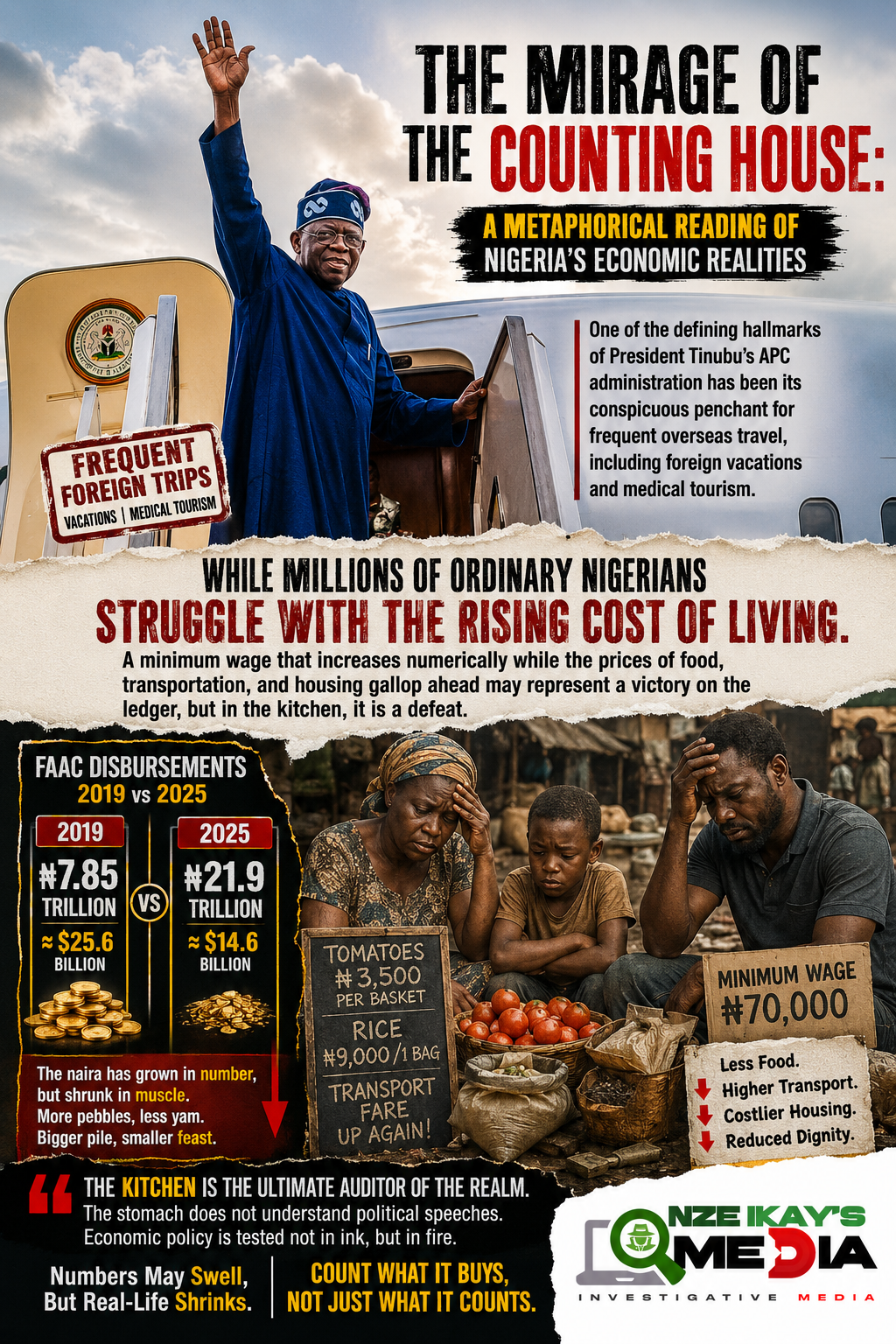
The current narrative surrounding FAAC allocations illustrates the problem. In 2019, the FAAC disbursements were a stream of approximately ₦7.85 trillion, which, when traded on the world’s exchange bazaar, was worth about $25.6 billion. By 2025, the nominal allocation had swelled to a roaring river of roughly ₦21.9 trillion. At first glance, this looks like a flood of prosperity. But convert that river back into foreign currency, and the landscape shifts dramatically: the 2025 figure represents a mere $14.6 billion, a substantial decline in the real weight of the nation’s purse compared with 2019.
So, what has actually increased? The volume of the currency, but not its weight in gold. It is like celebrating because a bucket now contains more pebbles while ignoring the fact that each pebble buys less yam, less rice, less fuel, and less medicine. A larger allocation is not a larger feast. What matters is the substance of the meal it can provide.
The Currency Has Grown in Number While Shrinking in Muscle
The deeper problem becomes visible when inflation and exchange-rate depreciation are brought into the conversation. Nigeria’s inflationary furnace has fundamentally altered the purchasing power of the currency. The Naira in a worker’s pocket today is not the same steely coin that worker carried home several years ago; it is a softer metal that bends more easily. This is why nominal salary increases can be a siren’s song, luring sailors to the rocks.
Suppose, for illustration, that a worker earning ₦700,000 per month in 2019 was holding a bag of roughly $2,000 at the prevailing exchange rate. A worker earning ₦2 million today might find that their bag contains only around $1,400, depending on the exchange rate used. On paper, the second worker earns almost three times as many Naira notes. In purchasing-power terms, however, the story is considerably less flattering. The salary has grown tall, but the economic dignity attached to that salary has not grown with it; it has been cut down at the knees. As Nigerians often say, “Aso l’ade n fi n wo, ṣugbọn bata ni n mọ ibi tí ẹsẹ̀ ń dun”, meaning, “clothes may make the appearance, but the shoes know where the feet hurt”.
The government may point to ₦70,000 as the new minimum wage, but the real question is not whether ₦70,000 is a taller stack of notes than the previous figure. The real question is: What can this stack of notes actually harvest from the market? Can it adequately cover the fields of food? The tolls of transportation? The roof of rent? The fire of electricity? The healer of healthcare? The seeds of school expenses? The threads of communication? The cloth of clothing? And the unexpected storms of emergencies? A minimum wage that rises numerically while the price of food, transportation, and housing gallops ahead is a victory in the ledger but a defeat in the kitchen.
The Kitchen Is the Ultimate Auditor of the Realm
There is an old African wisdom that says the stomach does not understand political speeches. The kitchen is therefore the most reliable treasury in Nigeria. It is the place where economic policy is finally tested, not in ink, but in fire. A family does not experience GDP growth in a spreadsheet. It experiences it at the market, where the price of a tomato can rewrite a budget. The mother standing before a tomato seller does not ask what the government’s revenue collection has done. She asks why the same coin that filled her basket last month now barely covers its bottom. The father does not measure economic recovery by the size of a FAAC cheque. He measures it by the steepness of transport fares, the height of school fees, the weight of rent, the wattage of electricity bills, and the shrinking portion of food on his children’s plates.
That is why the cost of living must be the main lighthouse in every conversation about economic progress. If government revenues rise while citizens’ purchasing power collapses, then the headline figure is like a castle built on sand, beautiful but without a foundation. And half a truth can sometimes be a more potent poison than an outright lie.
Subsidy Removal Cannot Become a Convenient Shield
The argument surrounding subsidy removal also deserves a more rigorous examination. There is a legitimate economic argument for removing the crutch of costly and inefficient subsidies. But removing a crutch does not automatically make a man run faster. The real question is: What happens to the strength saved, and what other wounds remain unhealed within the system? If Nigerians are asked to endure the heat of higher fuel prices, higher transportation costs, and higher food prices in the name of fiscal discipline, then government must demonstrate equal determination in closing the other windows through which public resources fly away.
Questions surrounding import waivers, tax concessions, customs exemptions, procurement inflation, capital flight, and abandoned or repeatedly budgeted projects cannot simply be swept under the rug of convenience. If enormous amounts of potential public revenue are being surrendered through poorly justified waivers or lost through the termites of inefficiency and corruption, then the citizen is entitled to ask why the burden of fiscal adjustment appears to fall disproportionately on the backs of ordinary Nigerians. One cannot continually squeeze the poor man’s throat while leaving the holes in the roof wide open for the rain to pour in.
The Graveyard of Abandoned Projects
Nigeria has developed another peculiar fiscal phenomenon: the budgetary reincarnation of unfinished projects. A road can appear in one budget cycle, remain a skeleton, return in another, receive another infusion of funds, and somehow continue its journey through the bureaucracy like a ghost that refuses to leave the village. The consequence is devastating. Every Naira tied up in an abandoned or inflated project is a seed that never germinates, a Naira unavailable for the harvest of healthcare, education, infrastructure, security, or productive investment. The result is an economy where governments can announce enormous budgets while citizens continue asking a painfully simple question: “Where is the monument?”
This is why accountability must go beyond announcing how much government has allocated. We must ask: How much was approved? How much was released? How much was actually spent? What was delivered? What did it cost? Who received the contract? Was the project completed? And, most importantly, does the citizen receive a golden egg for their coin? Until these questions become as routine as the sunrise, Nigeria will continue to confuse the size of a building with its architectural soundness.
Dangote Refinery and the Fragile Petroleum Vessel
The emergence of the Dangote Industries Limited refinery has also dramatically altered Nigeria’s petroleum landscape. Its scale gives Nigeria a potentially important domestic refining capacity and a buffer against complete dependence on imported refined petroleum products. It is a mighty anchor, but one anchor cannot secure a whole ship. The reported gap between refinery licences issued and facilities actually operating also raises important questions about Nigeria’s regulatory and investment environment. If numerous licences are issued like boarding passes but only a small proportion of the facilities become operational, policymakers should investigate the storms that prevent the ships from sailing.
Is the problem a lack of fuel? A tangled rigging? A turbulent foreign exchange? A dry well of crude? Broken infrastructure? Thieves on the pipeline? A heavy tax burden? Or simply an environment where only the largest galleons can brave the sea? An economy cannot claim to have established a competitive refining industry merely because licences exist on paper. A licence is not a refinery. A ribbon-cutting ceremony is not production. An announcement is not the roar of a working engine.
The Medical-Records Question Is Part of the Same Veil
The question of transparency also extends beyond economics. During the last presidential election cycle, calls for presidential candidates to disclose comprehensive medical information generated considerable controversy. It was a demand to see the engine that drives the state. The underlying principle was straightforward: voters should have sufficient information to assess the capacity of those seeking to captain the ship.
In many democracies, transparency concerning the health and capacity of senior public officials is treated as a legitimate matter of public interest, subject to privacy and legal safeguards. They believe a captain’s fitness is the crew’s business. Nigeria, however, has often operated behind a velvet curtain of secrecy. This reflects a broader culture of governance in which citizens are frequently asked to trust rather than verify. The people are told to admire the tapestry from afar, not to inspect its threads.
But democracy should not be a temple of blind faith. Public officials manage public treasure. They make decisions affecting millions of lives. They should therefore expect the lamp of scrutiny to be held to their work. Sunlight should not be regarded as an attack on the palace. Sunlight is how a palace proves it is a home, not a fortress of shadows.
The Difference Between Counting Coins and Valuing the Cattle
There is nothing inherently wrong with celebrating increased FAAC allocations. The problem begins when the headline figure is presented without its economic context. It is like celebrating the size of the flock without noticing the condition of the cattle. If ₦7.85 trillion once represented approximately $25.6 billion and ₦21.9 trillion later represents approximately $14.6 billion, then simply shouting that FAAC has increased from ₦7.85 trillion to ₦21.9 trillion gives Nigerians a broken compass.
We must ask what happened to the wind in our sails: purchasing power, exchange value, inflation, food prices, productivity, and living standards. That is the difference between fiscal arithmetic and economic wisdom. A government can collect more naira and still preside over a poorer population. A government can spend more money and still deliver less infrastructure. A worker can earn more naira and still afford less food. A state can receive more FAAC and still owe salaries, pensions, and contractors. And a country can announce economic growth while millions of households experience economic contraction in their daily lives.
Nigeria Must Stop Measuring the Shadow
The central challenge before Nigeria is therefore not merely how to fill the government’s coffer. It is how to ensure that every additional coin translates into a real feast on the table. We need transparent revenue accounting. We need credible expenditure tracking. We need independent auditing. We need open procurement. We need serious scrutiny of waivers and tax expenditures. We need accountability for abandoned projects. We need an environment where refineries and productive industries can actually operate. We need statistics that communicate not merely how many coins the government receives, but what those coins can buy.
Above all, Nigerians deserve an economic narrative that does not require them to wear rose-coloured glasses while standing inside an empty kitchen. Because ₦21.9 trillion is not automatically better than ₦7.85 trillion. A higher salary is not necessarily a better salary. A larger budget is not necessarily greater development. And a bigger FAAC allocation is not necessarily a richer Nigeria. The fisherman knows the difference between a swollen river and a river that teems with life.
Nigeria must stop measuring the size of the river’s flow and start asking how many fish are actually reaching the people’s nets. Until that happens, the country risks becoming trapped in the illusion of prosperity, where the numbers swell like a magnificent balloon on paper while the purchasing power of ordinary citizens quietly leaks out through the back door.
As the African proverb reminds us: when the music changes, the dance must change with it. Nigeria’s economic conversation must therefore move beyond nominal naira figures, political applause, and selective statistics toward something far more demanding: truth, transparency, purchasing power, and measurable value for the Nigerian people. Because at the end of the day, the economy is not the ledger. The economy is the life people are living, the food on their tables, and the hope in their hearts.
NzeIkayMedia ✍️
Disclaimer:
The sketches, images, pictures and videos are obtained from the public domain.