

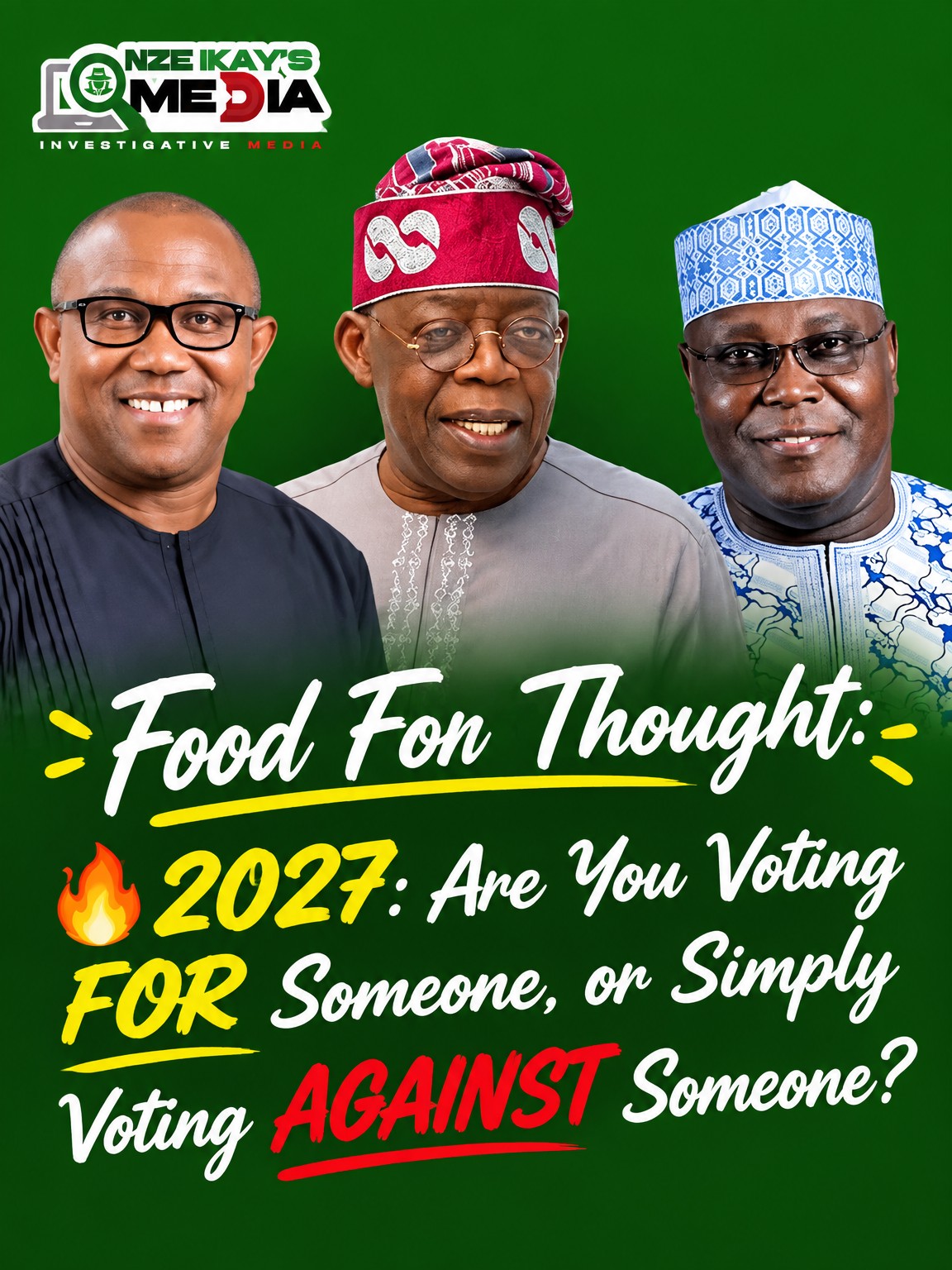
If your only reason for supporting a presidential candidate is that “the other person is worse,” then this article is about you.
Nigeria stands at the precipice of another presidential election, yet the true battle in 2027 may not be fought between political parties at all. It may be a tug-of-war between hope and fear. Between those yearning to chart a new course and those paralysed by the spectre of change. Between voters who believe Nigeria desperately needs a different breed of leadership and those who cling to the familiar as a life raft. Between citizens who want to vote for something and citizens simply desperate to vote against someone.
And this raises a question that gnaws at the conscience: When Nigerians step into the polling booth in 2027, will they cast their ballot for the candidate they genuinely believe can rebuild Nigeria, or will they mark an X against the candidate they despise the most? That distinction could be the hinge upon which the future of Africa’s most populous nation swings.
For decades, Nigerian politics has been less about what a candidate stands for and more about what, or whom, they stand against. Elections morph into referendums on personalities. Campaigns become gladiatorial battles of identity. Supporters defend their chosen one with almost religious fervour. At the same time, opponents become so consumed with demolishing the other candidate that they forget to explain what their own candidate would actually accomplish. The result is a political culture where “At least he is not the other person” passes as a perfectly acceptable electoral argument.
But is that enough? Can a nation of more than 200 million souls build a prosperous future on the shaky foundation of lesser evil? Can Nigeria become a serious economic and political powerhouse if elections remain merely exercises in choosing who we dislike least? Perhaps 2027 offers Nigerians an opportunity to ask a more dangerous question: What exactly are we voting for?
The Nigerian Voter Is Nobody’s Fool. One of the laziest assumptions in political discourse is that Nigerian voters are putty in the hands of manipulators. They are not. The Nigerian voter is often a calculating strategist operating under extraordinary circumstances. A man who has struggled to put food on the table may not approach an election like a political philosopher. A woman haunted by insecurity may prioritise safety above every economic manifesto. A young graduate who has worn out his soles searching for employment may judge politicians through the brutal lens of joblessness.
When survival becomes a daily battle, politics becomes deeply personal. This is why outsiders so often misread Nigerian voting behaviour. A voter may complain bitterly about a government and still support politicians associated with it. Another may passionately demand change but ultimately vote along ethnic, religious, regional or family lines. Someone else may reject all the major parties but choose one simply because that candidate appears capable of slaying the dragon they fear most.
Is that hypocrisy? Not necessarily. Sometimes it is survival. The Nigerian voter is often not asking, “Which candidate has the most sophisticated policy document?” He may be asking: “Who will protect my interests?” And that is a far harder question.
The Politics of Fear: A Formidable Weapon. There is an uncomfortable truth about elections everywhere: fear is often a more powerful political weapon than hope. Hope asks people to imagine a better tomorrow. Fear tells them what they stand to lose today. And fear is immediate; it grips the gut. Tell voters that Candidate A will transform the economy, and you are asking them to envision a tomorrow that may never come. Tell them that Candidate B will destroy everything they hold dear, and you have handed them an enemy they can see lurking in the shadows today.
This is why political campaigns can become extraordinarily emotional. Candidates do not always need to convince voters that they are perfect. Sometimes they only need to convince voters that the alternative is a disaster waiting to happen. Once that seed is planted, the election transforms. It stops being a contest over competence. It becomes a defensive battle. And the voter is no longer asking, “Who is best qualified to lead Nigeria?” The voter is asking: “Who must I stop?” That is a profoundly different electoral calculation.
Nigeria Cannot Keep Electing Presidents by Elimination
There is nothing inherently wrong with voting against a candidate. Every election involves rejecting alternatives. But there is a problem when rejection becomes the principal political philosophy.
Imagine choosing a surgeon by asking only which one you dislike least. Imagine selecting the pilot of a plane carrying hundreds of passengers because you are terrified of the other pilot. Imagine picking the managing director of a struggling company based entirely on whom the shareholders fear more. At some point, competence has to enter the conversation. Nigeria is too important to continue treating presidential elections as personality contests. The presidency is not a trophy. It is not compensation for political loyalty. It is not a reward for surviving party primaries. It is not an inheritance belonging to one region, generation, political dynasty or ideological camp. The presidency is an enormous responsibility.
The person occupying that office influences the direction of an economy, the credibility of institutions, national security, foreign relations, public investment and the confidence of millions of citizens. That should make one question unavoidable: Who is actually capable of doing the job? Not who has the loudest supporters. Not who has the largest political machinery. Not who has the most powerful godfathers. Not who can produce the biggest crowd. Not even who can deliver the most emotionally satisfying speech. Who can actually govern? Competence Must Become More Than a Campaign Slogan.
For years, Nigerians have demanded “competent leadership.” But competence cannot simply mean that a politician speaks well. It cannot mean that someone has impressive academic credentials. It cannot mean that someone has occupied public office for decades. And it certainly cannot mean that someone belongs to the political camp we already support.
Competence should mean measurable ability. Can the candidate manage public resources responsibly? Can the candidate attract investment? Can the candidate improve infrastructure? Can the candidate strengthen institutions? Can the candidate make difficult decisions? Can the candidate assemble capable people rather than merely loyal people? Can the candidate admit mistakes? Can the candidate resist pressure from political allies? Can the candidate make appointments based on ability rather than patronage? Can the candidate leave Nigeria stronger than they found it? These questions should matter more than slogans.
And perhaps the most important question is this: What evidence do we have? Nigeria should become increasingly uncomfortable with political promises unsupported by evidence. If a politician says they can transform education, Nigerians should ask how. If they promise jobs, Nigerians should ask where the jobs will come from. If they promise security, Nigerians should ask what institutional reforms will produce it. If they promise economic growth, Nigerians should ask what sectors will drive that growth. If they promise to fight corruption, Nigerians should ask whether they will tolerate corruption among their own supporters. The age of political poetry should give way to the age of political accountability.
But Can Nigerians Escape Identity Politics? This is where the conversation becomes uncomfortable. It is easy to demand that Nigerians vote based on competence while ignoring the deep historical reasons why identity matters. Nigeria is an extraordinarily diverse country. People carry memories of political exclusion, regional competition, religious suspicion and historical grievances.
For many voters, politics is not an abstract exercise. It is connected to questions of belonging. “Will people from my community have a voice?” “Will my region be remembered?” “Will my religion be respected?” “Will my people be safe?” Those concerns cannot simply be dismissed as ignorance. But neither should they become permanent barriers to national political judgment. There is a difference between wanting representation and surrendering one’s political judgment.
A candidate can come from your region and still fail you. A candidate can belong to another ethnic group and still serve you better. A politician can share your religion and still govern badly. A politician can come from a completely different background and still demonstrate the competence, integrity and vision required to move Nigeria forward. The Nigerian voter must eventually reach the point where identity informs political judgment, but does not replace it.
And What About Peter Obi, Tinubu, Atiku, Kwankwaso and Everyone Else? The personalities will dominate the conversation. They always do. Supporters will insist that their preferred candidate is the answer. Opponents will insist that the same person is the problem. Social media will amplify every speech, photograph, controversy and mistake. Political influencers will manufacture narratives. Supporters will turn politicians into heroes. Opponents will turn them into villains.
But Nigerians should resist the temptation to allow political personalities to become substitutes for political analysis. The real question should not be: “Which politician do you love?”
It should be: “Which candidate has earned your vote, and why?” There is a huge difference. Love is emotional. A vote should be accountable. If you support Peter Obi, explain the policies and record that convince you. If you support Bola Tinubu, explain what you believe his leadership has achieved and what you expect from him going forward. If you support Atiku Abubakar, explain why you believe his programme and experience make him the strongest choice. If you support Rabiu Kwankwaso, explain why his record and political vision persuade you. And if you support another candidate, the same standard should apply.
The politician should not be placed above scrutiny simply because the voter has emotionally identified with him. The Most Dangerous Voter Is Not the Angry Voter. The angry voter can still be persuaded by evidence. The disappointed voter can still reconsider. The undecided voter can still listen. The most dangerous voter is the one who has surrendered judgment completely.
The voter who says: “My candidate can do no wrong.” That voter is a ticking time bomb for democracy. Because democracy requires citizens capable of criticising the people they elected. A candidate who cannot be questioned by his own supporters is already beginning to resemble something other than a democratic leader. Nigeria does not need political disciples. Nigeria needs citizens. Citizens who can say: “I support this candidate, but I disagree with him on this issue.” “I voted for this government, but I will criticise it when it fails.” “I belong to this party, but Nigeria comes first.” That is how mature democracy works.
2027 Should Be an Examination, Not a Tribal War. Perhaps the greatest opportunity of 2027 is not merely choosing a president. It is changing the way Nigerians choose presidents. Imagine an election where candidates are forced to answer the same fundamental questions. How will you reduce unemployment? How will you reform the power sector? How will you improve public education? How will you address insecurity? How will you make government more transparent? How will you reduce waste? How will you strengthen the Naira and the productive economy? How will you protect institutions from political interference? How will you attract and retain Nigerian talent? How will you ensure that government contracts serve the public rather than private interests?
And, most importantly: What will you do differently from those who came before you? Then let Nigerians judge the answers. Not according to accent. Not according to ethnicity. Not according to religion. Not according to social-media popularity. Not according to the size of campaign rallies. But according to evidence, credibility, character, competence and vision.
The Choice Nigeria Faces. The greatest mistake Nigerians could make in 2027 would be to assume that changing the person automatically changes the system. It does not. A president matters enormously, but institutions matter too. A good leader can accelerate reform. A bad leader can deepen dysfunction. But no leader should be treated as Nigeria’s messiah. Nigeria does not need a saviour. Nigeria needs functioning institutions, competent leadership, accountable public officials, productive citizens and voters willing to demand more.
That is why the question of 2027 goes beyond Tinubu, Obi, Atiku, Kwankwaso or anyone else who eventually stands on the ballot. The deeper question is about the Nigerian voter. Have we learned enough from our political history to stop voting merely out of fear? Can we disagree without demonising? Can we scrutinise our own candidates as aggressively as we scrutinize their opponents? Can we demand evidence? Can we judge performance? Can we reject incompetence even when it comes wrapped in the colours of our preferred party? Because ultimately, politicians do not create political culture alone. Voters do too.
Every time we reward mediocrity, we teach politicians that mediocrity is acceptable. Every time we excuse corruption because “our man” is involved, we strengthen corruption. Every time we defend failure because we fear the alternative, we make failure politically profitable. And every time we demand competence regardless of who offers it, we raise the standard of Nigerian politics.
So, What Will You Do in 2027? Will you vote for your candidate? Or will you vote against somebody else’s candidate? Will you ask what your preferred politician can actually deliver? Or will you spend the next year explaining why the other politician is worse? Will you defend your candidate at all costs? Or will you hold him or her to the same standard you demand from everyone else?
The answer may matter more than any campaign slogan. Because Nigeria’s future will not be determined solely by the politicians who appear on the ballot. It will also be determined by the millions of Nigerians who decide what qualifies a politician to receive their vote. Perhaps 2027 should therefore not be about finding a politician we love. Perhaps it should be about finding a leader we can justify voting for.
And if no candidate meets that standard, perhaps the real political revolution Nigeria needs is for voters to stop lowering the bar simply because election day has arrived. Nigeria cannot afford another election in which the central question is merely, “Who do we fear the most?” The question should be: “Who has earned the right to lead us?” That is the question Nigerians should be asking now, not when the campaigns become deafening, not when social media becomes toxic, and not when political parties begin distributing promises like confetti. Because by the time Nigerians reach the ballot box in 2027, the most important decision will already have been made: Whether we are still voters looking for someone to defeat, or citizens looking for someone worthy of leadership.
Let’s be honest: if the 2027 election were held tomorrow, would you be voting FOR your preferred candidate, or AGAINST someone else? And what specific evidence would justify your choice?
NzeIkayMedia ✍️
Disclaimer:
The sketches, images, pictures and videos are obtained from the public domain.