

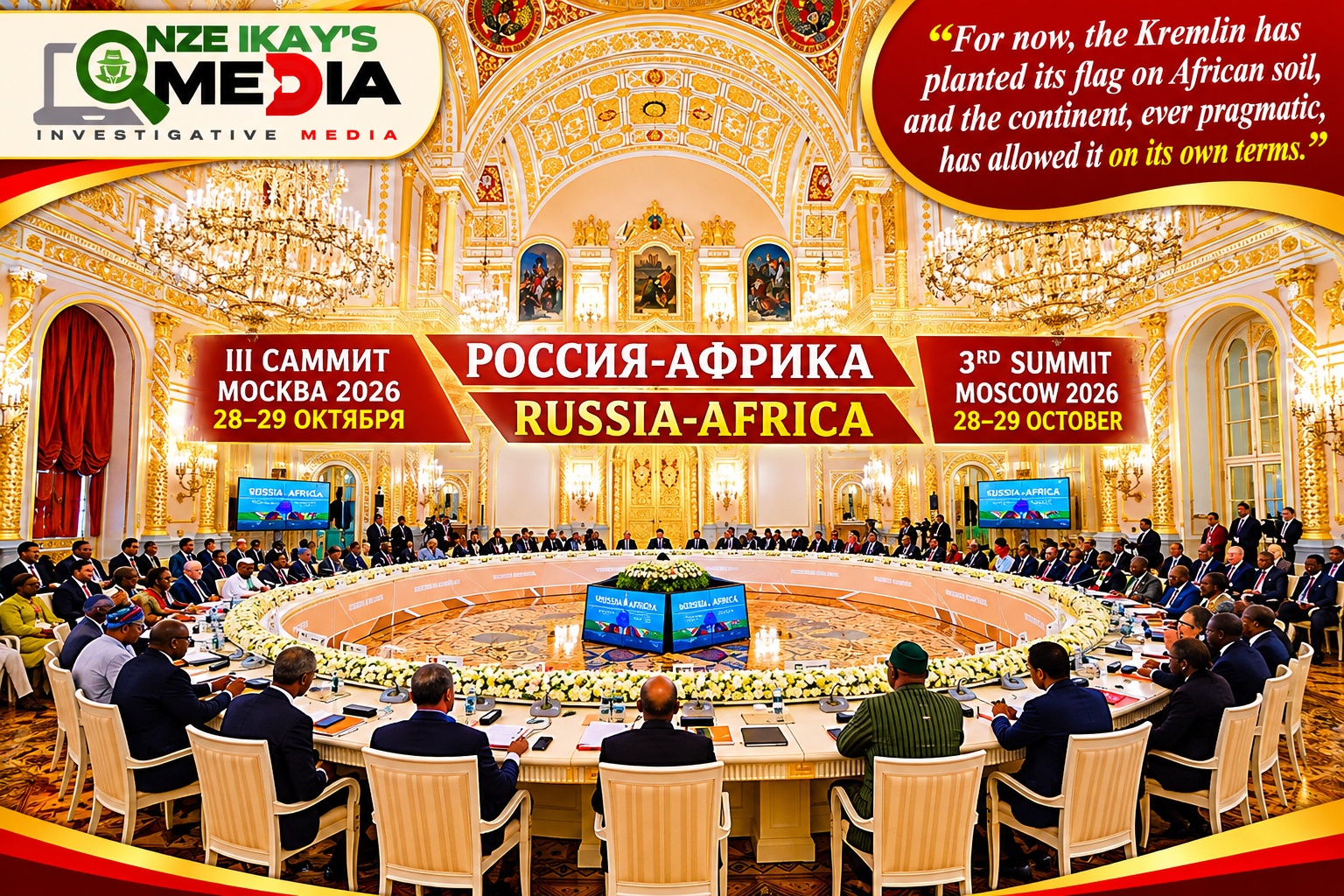
Moscow rolled out the red carpet in late October 2026, precisely on the 28th and 29th of October 2026, but the welcome mat was more than velvet, it was a calculated geopolitical statement. The Third Russia-Africa Summit, held within the gilded halls of the Grand Kremlin Palace, brought together representatives from 48 African nations, including 22 heads of state, under the banner “For Peace, Security and Development”. President Vladimir Putin stood at the podium not as a supplicant seeking friends, but as a self-styled architect of a new world order, casting Russia and Africa as “natural allies” against the crumbling edifice of Western hegemony. Yet beneath the pomp and the promises, a more complex tapestry emerged, one woven with threads of genuine economic opportunity, strategic convenience, and the unspoken calculus of a continent learning to play suitors against one another in an increasingly multipolar bazaar.
Putin’s central refrain was unmistakable: the age of a handful of nations dictating the fate of continents is over. “A multipolar world is becoming a reality,” he declared, “an irreversible trend”. To underscore the shift, he wielded numbers like a cudgel: the BRICS bloc now generates over 40% of global GDP, while the G7’s share has shriveled below 30%. Africa, he insisted, must be seated at the table where the real decisions are made, particularly within the International Monetary Fund, the World Bank, and, most contentiously, the UN Security Council. Kenyan President William Ruto echoed the sentiment with surgical precision: “The international order must reflect the world as it is today, not the world as it was in 1945” . Putin, seized the moment: “The absence of African representatives at the UN Security Council is unfair”. Whether this was genuine advocacy or a wedge driven into Western consensus mattered little; the optics were impeccable, and the applause was real.
The Kremlin’s grievance narrative found a receptive audience. Putin framed Western sanctions and tariff wars not as responses to Russian aggression, but as “instruments of neocolonialism”, the same chains that once bound Africa, now repackaged in legalistic language. Moscow welcomed the “firm position” of African states that rejected these restrictions, a diplomatic nod to those who have refused to join the West’s isolation campaign. More concretely, Putin pushed for a financial architecture that bypasses the dollar’s long shadow. Russia and African nations, he argued, must establish settlements in national currencies, a move already bearing fruit: the Ruble’s share in Russia-Africa commercial transactions has reached 85%. This is not merely technocratic tinkering; it is the quiet construction of a parallel plumbing system for global trade, one that Western sanctions cannot easily unclog.
Away from the grand declarations, the summit produced a staggering paper trail: 92 agreements and 54 memoranda were signed, alongside three overarching summit documents . Trade turnover between Russia and Africa has climbed to $27 billion, a 1.5-fold increase since the previous summit . But Putin was careful to distinguish Russian commerce from colonial extraction. Russian companies, he insisted, do not “siphon off profits in the manner of former imperial powers” but reinvest earnings, share technologies, and engage local subcontractors.
Food security emerged as Russia’s headline contribution. In 2025, Moscow shipped over 18 million metric tons of grain to Africa; in the first nine months of 2026 alone, another 13 million tons followed. Fertilizer exports have already surpassed 2.2 million tons this year, up from 1.5 million in 2025 . Putin painted a vision of African agricultural self-sufficiency, with Russian expertise as the midwife. “Africa in the future,” he predicted, “will be able not just to feed itself but to become a major exporter”. In energy, over 30 Russian projects are underway across 16 African countries, spanning nuclear power, natural gas, and mining. The pitch is simple: Russia offers technology and political cover; Africa offers markets, resources, and votes at the UN.
Perhaps the most enduring investment is not in pipelines or grain silos, but in minds. Nearly 40,000 African students now study at Russian universities, a 50% increase since 2020, with scholarship quotas raised to 5,500 for the 2026-2027 academic year. Russia has also committed to establishing production of Russian medicines and vaccines on African soil. These are seeds planted for a harvest decades hence, doctors, engineers, and policymakers who will carry a Russian imprint into Africa’s future corridors of power. As one Kremlin aide bluntly admitted, educating African students benefits Russia because “later they will become the people Moscow can rely on”.
For all the rhetoric of brotherhood, the summit was a transaction, and both sides knew it. African leaders did not arrive as beggars. Burundi’s President Évariste Ndayishimiye, speaking as African Union chair, put it plainly: “Russia has become an all-weather friend: in snow and in rain, Russia remains with us, shoulder to shoulder”. But he also stressed that African nations came “not only to ask for help, but to strengthen partnership”. The continent’s leverage has grown precisely because the world has grown multipolar; African states can now court Russia for security guarantees and arms while maintaining ties with China, the EU, and the United States. They are no longer pawns but players, and Moscow understands this. The Kremlin’s concessions, on UN representation, on debt relief whispers, on technology transfer, are the price of admission to a continent that no longer answers to a single master.
The Third Russia-Africa Summit was, in the end, a mirror held up to a changing world. Putin’s Moscow offered Africa a vision of partnership without paternalism, investment without extraction, and a seat at the table of nations, all while quietly advancing Russia’s own campaign to fracture Western unity and build alternative arteries of trade and finance. Africa, for its part, accepted the embrace with open eyes, pocketing grain, scholarships, and diplomatic support while refusing to sever ties elsewhere. The declarations signed in the Kremlin’s gilded halls may gather dust, but the currents they reflect, the drift toward multipolarity, the revolt against dollar hegemony, the assertion of African agency, are as real as the grain ships docking in Mombasa and the Rubles changing hands in Lagos. Whether this summit becomes a footnote or a hinge of history depends less on the eloquence of speeches than on the follow-through of promises. For now, the Kremlin has planted its flag on African soil, and the continent, ever pragmatic, has allowed it, on its own terms.
NzeIkayMedia ✍️
Disclaimer: The sketches, images, pictures and videos are obtained from the public domain.