

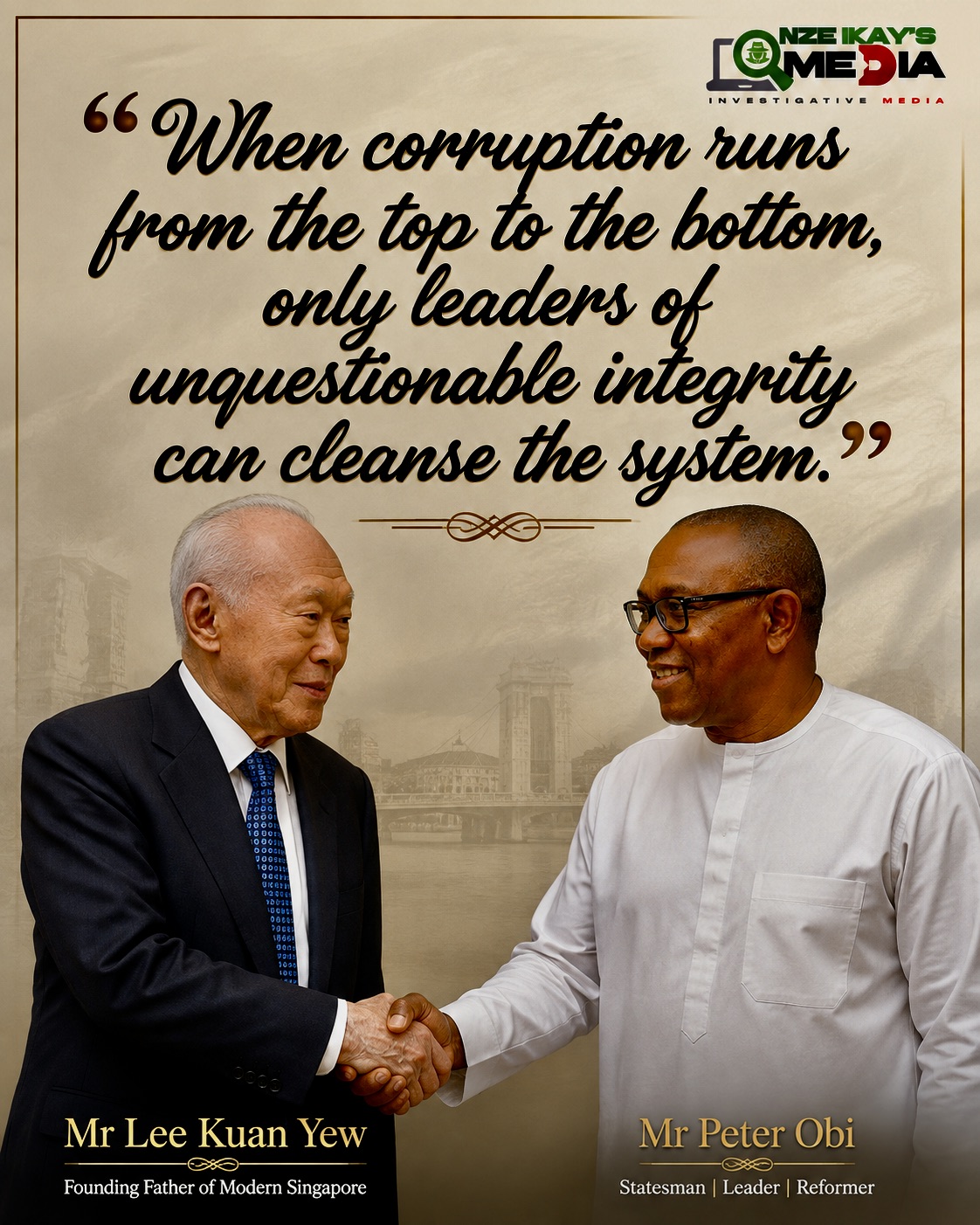
“Once a political system has been corrupted right from the top to the lowest ranks of the bureaucracy, the problem is almost impossible to solve without a revolution. The cleansing and disinfecting must start from the top down, thoroughly and systematically. It is a long and laborious process that can be carried out by a very strong group of leaders with the courage and moral authority derived from unquestionable integrity.”
— Lee Kuan Yew (1923–2015), Singapore’s founding Prime Minister
Unquote:
Lee Kuan Yew’s warning reads like a diagnosis delivered in the language of surgery. When corruption infects a nation “from the top to the lowest ranks,” ordinary reforms become little more than bandages placed over a gangrenous wound. What is required is a radical and carefully administered cleansing—one that begins at the summit of power and descends relentlessly through every layer of government. Such a cure can succeed only under leaders whose courage is strengthened by unquestionable integrity.
The Meaning Behind the Warning
Lee Kuan Yew (1923–2015), Singapore’s founding Prime Minister, was the principal architect of his country’s transformation from a small, resource-poor port into one of the world’s most prosperous and least corrupt nations. He understood that corruption is not merely a moral weakness in individuals; when tolerated, it becomes a cancer within institutions, spreading from office to office until dishonesty begins to resemble normal administration.
For Lee, public office was a sacred trust, not a private marketplace. He insisted on a clear separation between public funds and personal wealth, merit-based appointments, strict accountability, and leaders who embodied integrity instead of offering excuses for its absence.
The language of the quotation is especially powerful:
“Corrupted right from the top to the lowest ranks” portrays the bureaucracy as a body poisoned at every level—not merely a government containing a few “bad apples,” but an entire orchard in danger of decay.
“Cleansing and disinfecting” presents the fight against corruption as a painful but necessary medical procedure. The process must be thorough, systematic, and uncompromising.
“A very strong group of leaders” reminds us that no nation can be rescued by one speech, one law, or one heroic personality. Reform requires a disciplined coalition of people willing to confront corruption, including when it benefits their own allies.
“Moral authority derived from unquestionable integrity” reveals the heart of Lee’s argument: those appointed to heal the system must not themselves be suspected of profiting from its sickness.
His central message is clear: once corruption becomes cultural and institutional, cosmetic reforms are inadequate. The cure must be sustained, courageous, and led from the very top, with consequences that are visible, impartial, and unavoidable.
Nigeria: A Nation at the Crossroads
Lee Kuan Yew’s warning appears painfully relevant to present-day Nigeria. My country’s recent headlines often read like case studies in the very condition he described: a system in which corruption is no longer an occasional intrusion into public administration but, in many instances, appears to have become part of its operating machinery.
Phantom institutions and public funds
In 2026, President Bola Tinubu ordered investigations after a fictitious federal body, the Presidential Foreign Investment Promotion Council, reportedly appeared in the national budget with an allocation of approximately ₦1.3 billion, despite not having been established by law. A businessman subsequently told a parliamentary panel that he had paid hundreds of millions of naira for contract facilitation connected to the alleged scheme. The ICPC later recommended prosecution of the alleged mastermind.
Soon afterwards, another suspected fake agency was uncovered within the Office of the Secretary to the Government of the Federation, leading to arrests and the suspension of senior officials. These incidents raise an unsettling question: if phantom institutions can find their way into official documents and public budgets, how many other weaknesses remain hidden beneath the surface?
Missing money and opaque spending
Politicians and analysts have also drawn attention to enormous revenue leakages and off-budget expenditure. One prominent claim cited approximately ₦34.4 trillion in unremitted federation revenue over three years, while another referred to roughly ₦8.83 trillion in expenditure that was not reflected in the budget.
Although individual figures may require further verification, clarification, or reconciliation, the broader pattern has deepened public anxiety. Citizens are left wondering how a nation can fund development, protect the vulnerable, and build a productive economy when vast sums appear to disappear into the shadows of poor accounting, opaque contracts, and weak oversight.
A troubling corruption record
Nigeria’s score of 26 out of 100 on the 2025 Corruption Perceptions Index, together with continuing concerns about the judiciary, legislature, security agencies, the oil sector, and public procurement, reflects the persistence of structural weaknesses. Reports of ghost workers and payroll fraud further demonstrate how corruption can penetrate even the routine mechanisms of government.
From inflated contracts and abandoned projects to fraudulent payrolls and undisclosed expenditures, the same pattern repeatedly emerges: public resources intended to build schools, hospitals, roads, industries, and a better future are diverted before they can serve the people.
Together, these episodes create the impression of a state in which corruption is not an isolated malfunction but a deeply rooted operating logic, from budget offices in Abuja to ministries, departments, and agencies across the federation.
Why the Metaphor Hurts
Lee’s metaphor is uncomfortable because it forces Nigeria to confront several painful truths.
First, the infection begins at the top. When fictitious councils or agencies can enter official budgets and receive public funding, the situation suggests either complicity at high levels or a catastrophic failure of supervision and accountability.
Second, half-measures cannot cure a systemic disease. Asset recovery and the prosecution of a few individuals are important, but they will not disinfect a system in which ghost workers, opaque expenditure, phantom agencies, procurement fraud, and weak judicial accountability continue to coexist.
Third, integrity must be visible, consistent, and costly. Lee’s phrase “unquestionable integrity” demands leaders who obey the same laws they impose on citizens; publish and explain their assets; submit to independent audits; welcome scrutiny; and punish allies as firmly as opponents when corruption is established.
In Nigeria, the “revolution” Lee mentioned need not be violent. It can be a constitutional, political, administrative, and moral revolution—a transformation of the way public office is understood and exercised. It would require a determined alliance of honest political leaders, independent institutions, principled civil servants, courageous journalists, responsible civil society organisations, and citizens who refuse to celebrate stolen wealth.
What Cleansing Would Require
If Nigeria is to take Lee Kuan Yew’s warning seriously, an effective anti-corruption campaign must go beyond slogans and occasional arrests.
Leadership by example: The Presidency, governors, ministers, and senior officials must embrace full asset disclosure, transparent procurement, independent audits, and public explanations for major expenditures.
Strong institutions, not selective punishment: The ICPC, EFCC, courts, auditors, and legislative oversight bodies must be sufficiently independent, properly funded, and protected from political interference.
Digital transparency: Budgets, contracts, payments, and project outcomes should be published in accessible, machine-readable formats so citizens can follow public money from allocation to completion.
Protection for truth-tellers: Whistleblowers, investigative journalists, auditors, and civil servants who expose corruption must be protected rather than persecuted.
Equal justice: The law must not be a net that catches only the weak while powerful individuals swim freely through it.
A coalition of integrity: Nigeria does not need one mythical saviour. It needs a strong, principled group of leaders who will defend the public interest even when corruption touches their own party, associates, or benefactors.
A Hopeful Ending
Lee Kuan Yew’s quotation is powerful because it is both severe and hopeful. It is severe because it acknowledges that once corruption becomes systemic, the cure will be long, painful, expensive, and politically dangerous. It is hopeful because it insists that determined and morally credible leadership can still restore a wounded nation.
Nigeria is not condemned to remain a permanent victim of corruption. The country possesses immense human talent, natural resources, entrepreneurial energy, and a resilient population. What has been lacking is not ability, but the consistent moral and institutional discipline to place the common good above private gain.
The question, therefore, is not whether Lee’s diagnosis applies to Nigeria. In many respects, it does. The deeper question is whether Nigerians are prepared to demand leaders who will cleanse the system from the top down—and whether such leaders will possess the courage to confront corruption even when it stands beside them.
For many Nigerians who long for a new political direction, Peter Obi represents the possibility of beginning that work: laying the foundation for a Nigeria in which public office is once again a calling, public money is treated as a sacred trust, and leadership is measured not by the splendour of its promises but by the integrity of its service. The road to renewal will be long, but every great national transformation begins when a people decide that decay is no longer acceptable.
NzeIkayMedia ✍️
Disclaimer:
The sketches, images, pictures and videos are obtained from the public domain.