

It seems that begging has been normalised in Nigeria. It is ubiquitous. Virtually everybody is begging, irrespective of status. The only difference is the type of begging and the target of the begging. Those at the top of the ladder get begged by those under them and the chain continues downwards. Social media has even made it easier, giving it a veneer of anonymity, which helps to blunt the shame associated with it. The popular term “Urgent 2K” is a product of that begging via social media, which is a request many Nigerians receive regularly from known and unknown social media contacts.
At the airports – local and international – the staff line up seemingly looking like professionals waiting to do their work. But behind the façade is a different picture. Begging and exploitation are writs large on that picture. This time around, all the beggars are in different uniforms: the immigration service, anti-terrorist group, customs, airport staff, or airline staff. Sometimes the begging is subtle, with exaggerated greetings and smiles. If the person being greeted does not get the message, the message is made obvious: “Oga, anything for us? Any mineral or water for us?” At international airports, threats are employed. Certain food items are tagged contraband that will be confiscated except if the owner pays a certain amount of dollars. Many feel helpless and part with some money.
If you play ball and continue doling out cash to these beggars in uniform, you will be given express treatment. But if you “don’t cooperate,” they will turn aggressive and search your bags with anger and scatter the contents. And all kinds of hurdles will be placed on your way to frustrate you and make you miss your flight. At eateries or banks, it is the same story. The security personnel or those who attend to customers make a show of greeting you. The tone and outlandish manner of the greeting sends the message to you that you should “shake bodi.”
At interstate public bus parks, one meets them. Once the bus is full or stops at the nearest filling station to fill the tank, a man appears. Sometimes he may stand beside the bus or even get on the bus. He starts singing Christian choruses and gives a charged sermon and prayer. Then he distributes envelopes and asks for offerings. Naturally, the thought of accidents and deaths flies around the mind of most travellers, which tends to make them more generous at such times. Near the embassies, there are well-dressed beggars waiting to exploit those who are happy that they have got their visas. They study people to know those to approach. Those who look happy are the usual targets because they have likely received their visa and will be more willing to part with some money when approached with a story.
On the streets, there are many well-dressed people walking up and down just looking for the next victim to tell a story that will elicit pity. If it is not the story of how they lost their wallet, it is a story about how their relative is hospitalised and needs a certain amount of money to be treated. From week to week, month to month, many of them maintain the same story, because they know that there is a low chance of meeting the same person twice. But sometimes, they run out of luck and meet the same person they told the same story weeks before. Even when that happens, they are not fazed. They simply grumble about their victim disturbing them and then move on to target another person.
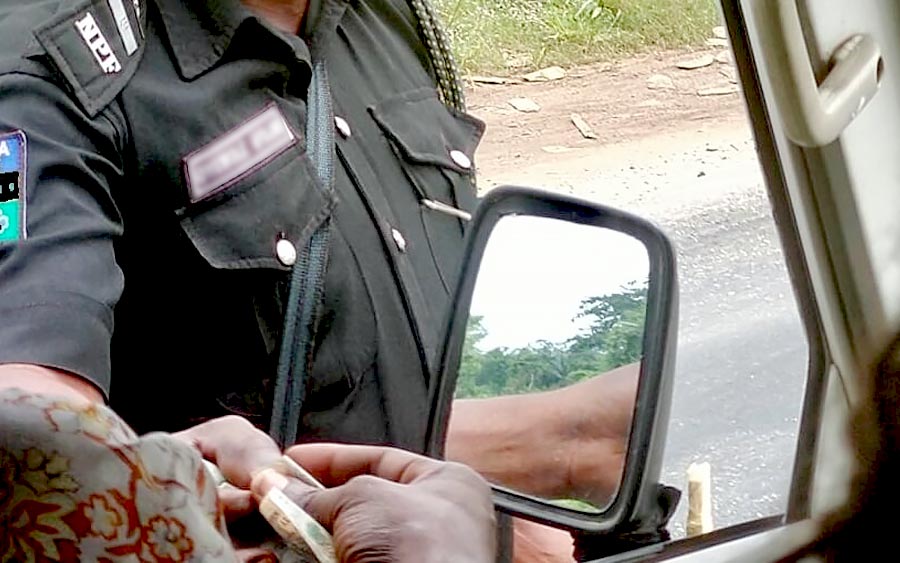
There is no need to mention the police and their known begging culture. The regular ban on police checkpoints by successive inspectors general of police has not reduced the incidence of street begging by the police. Roadblocks are mounted for different reasons but begging and exploitation are the intrinsic reasons. On social media, it is an everyday occurrence. People send private messages to others, telling different stories. It is usually about hunger or rent or hospital bill or school fees. These messages are sent to as many people as possible with the hope that a percentage of them will be positive.
All over the nation, the culture of begging has solidified. Once upon a time in Nigeria, begging used to be seen as a thing of shame. Even though many people believed that only the physically challenged should beg, many physically challenged people frowned at begging as demeaning. For example, I remember an interview I had with Mr Cosmas Okoli in 2008 for my book, 20 Success Secrets of Great Achievers. He said he suffered polio at four and was crippled since then. But he went on to acquire education and become an employer of men and women, including those with no physical disabilities. For him, the worst thing one can do to someone with physical disabilities is to give the person alms. Such alms-giving was tantamount to condemning that person to a life of beggary and ineffectiveness. A person with a physical challenge would be better off if helped to start earning a living, he argued.
Therefore, if those with physical disabilities are being discouraged from begging, what should be said to physically fit employees concerning beggary? For me, there is something demeaning about direct or indirect begging. When someone ingratiates oneself to me with a surfeit of greetings, praises and niceties, all in the name to get some naira notes from me, I feel ashamed on behalf of that person. All sense of decency and worth has been thrown to the dogs. People compete on who would beg harder and who would make higher returns at the end of the day. Funnily enough, some people usually claim that it is because of poverty, lack of jobs, and all the defeatist reasons. But it has nothing to do with poverty or low remuneration. It has all to do with a lack of self-respect and self-worth. It is the same spirit that breeds fraud and bribery and corruption. It is the desperate and never-satisfied spirit; the spirit of nothing-goes-for-nothing.
While beggary feels disgusting to me as an individual, I feel horrified when such a begging attitude is extended to foreigners within Nigeria. You would think that such professional beggars in uniform would respect themselves at the sight of a foreigner, just to keep the shame local. No. At the sight of a foreigner, the expectation rises. And when such foreigners part with some dollar or euro notes, they are hailed as great people and waved on, without a proper check. Begging by men and women in uniform and other workers should be frowned upon by all three levels of government. These three levels of government should take measures to reduce begging. A bank has made its staff, including security officers, not beg. Therefore, it is possible to kill the begging culture if only it is seen as a vice.
Citizens should also use their camera phones to record and publish such acts for the authorities to take action. Official begging is an embarrassment to the nation. Any society with a high level of workers who beg will also have a high level of corrupt officials and inefficient officials who will be more concerned with what they will get from everyone they attend to than doing their work effectively. That is why this begging culture is dangerous.
Twitter: @BrandAzuka
Disclaimer:
The opinions and views expressed in this write-up are entirely that of the Writer(s). They do not reflect the opinions and views of the Publisher (Nze Ikay’s Blog) or any of its employees. The designations employed in this publication and the presentation of materials herein do not imply the expression of any opinion whatsoever of the Publisher (Nze Ikay’s Blog) or its employees concerning the legal status of any country, its authority, area or territory or concerning the delimitation of its frontiers. Equally, the sketches, images, pictures and videos are obtained from the public domain.