


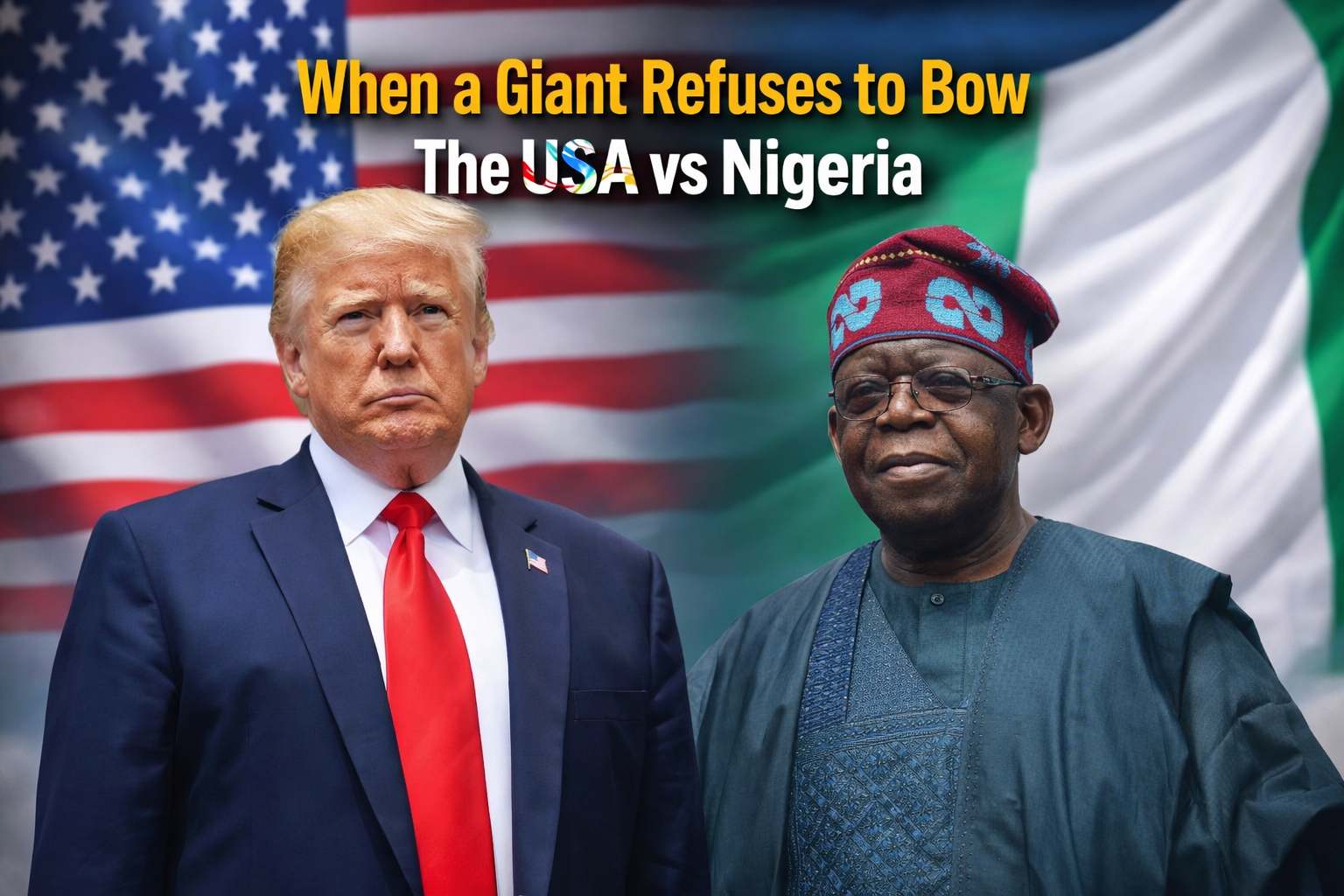
What happens when a nation, once expected to kneel, digs in its heels and stares down a goliath? We are not merely spectators to a diplomatic spat; we are witnessing a seismic shift in the world order, playing out in real time. Nigeria, Africa’s demographic and economic titan, is standing its ground against a thunderous threat from the United States, a threat of military force from the Trump administration that has sent shockwaves across the globe. But to dismiss this as another Twitter tempest is to miss the forest for the trees.
This is the unmistakable crack in the foundation of American primacy. For decades, the script was written in Washington, and middle powers followed their cues. Today, that script is being torn up. While the world covets Nigeria’s treasure trove of oil, gas, and rare earth minerals, a far more valuable commodity is on display: sovereign will. Nigeria’s defiance is not a solo act but a chorus rising across Africa, a collective refusal to be strong-armed into the old patterns of coercion.
The era when a gunboat on the horizon could dictate terms is fading into history. We are now in the age of calculated defiance, where nations are doing the math and concluding that the cost of submission far outweighs the peril of standing firm. The pivotal question is no longer whether the threat will be acted upon, but what this high-stakes chess game reveals about the crumbling architecture of global power. Are we lurching toward the bargaining table or the brink of disaster?
To understand how we reached this precipice, one must trace the footsteps of history. Nigeria’s resolute posture didn’t spring from a single presidential tweet; it is the bitter fruit of decades of grievances and broken covenants. Speaking with leaders in Lagos and Abuja, one detects not the heat of anti-Americanism, but the deep freeze of disappointment. The promised land of partnership and prosperity never materialised. Instead, Nigeria was handed a devil’s bargain: structural adjustment programs that hollowed out its social fabric, trade deals that favoured foreign interests, and security cooperation that often seemed more concerned with American priorities than with Nigeria’s own fight against terror.
President Trump’s bellicose warnings did not appear out of thin air; they were the predictable backlash to a series of moves by Washington that have backfired spectacularly. A key flashpoint is Nigeria’s burgeoning alliance with China. This is no mere fling; it is a strategic marriage built on concrete and steel, railways, ports, and telecom networks that Western partners had long promised but never delivered on acceptable terms. When the West offered loans with strings that would have strangled Nigeria’s economic sovereignty, China presented an alternative: tangible development without the surrender of autonomy. While Beijing’s model has its own pitfalls, the contrast is stark: on one hand, gleaming new infrastructure; on the other, a mountain of World Bank reports that never paved a single mile of road.
Then came Nigeria’s masterstroke in the global energy game. In the wake of the Ukraine crisis, as Europe scrambled for gas, Nigeria found itself holding a royal flush, vast natural gas reserves that granted it unprecedented leverage. But instead of simply feeding the West’s hunger, Nigeria played its hand with brilliance. It demanded technology transfers, majority ownership for its companies, and climate support for a sustainable transition. In short, it leveraged its resources not as a supplicant, but as a sovereign architect of its own destiny. This assertive pragmatism caught Washington flat-footed.
On the diplomatic stage, Nigeria has also carved a path of principled independence. Its abstention on UN votes condemning Russia was a thunderous silence, speaking volumes. It was a rejection of what many see as selective outrage, a refusal to grant the moral high ground to nations that had themselves rewritten the rules of sovereignty in Iraq and Libya. Nigeria will no longer be a puppet on a string, choosing instead to weigh each issue through the lens of its own national interest and a consistent ethical compass.
This philosophy of “strategic autonomy” is resonating across Africa. In concert with nations like South Africa and Kenya, Nigeria is championing a vision where countries are not forced to pick a side in a new Cold War, but can instead partner selectively to serve their own development. This represents a direct challenge to a world order built on vassal-like allegiances.
The immediate trigger for Washington’s ire, however, was the shot heard around the financial world: Nigeria’s announcement that it would accept payment for its oil in currencies other than the U.S. dollar. To understand the gravity of this, one must appreciate the dollar’s role as the lifeblood of American economic power, a privilege that allows the U.S. to wield the financial equivalent of a nuclear weapon. When a nation of Nigeria’s stature begins to chip away at this pillar, it threatens the very foundation of American hegemony. Trump’s response was not just a warning; it was a vow of vengeance, explicitly tying military action to an economic decision.
Nigeria’s counter has been a masterclass in calm, strategic resolve. President Bola Tinubu, rather than answering fire with fire, has delivered a message of steely determination, affirming that the nation’s economic sovereignty is non-negotiable. Behind the scenes, Abuja is weaving a diplomatic safety net, rallying the African Union, courting BRICS nations, and appealing to European allies who are uneasy with American heavy-handedness. The goal is to make the cost of military intervention so prohibitively high that even the most hawkish administration would blanch. This is asymmetric warfare waged not in the trenches, but in the halls of global power.
Of course, Nigeria is no monolith. It is a tapestry of complex, sometimes conflicting, identities, a nation grappling with deep internal divisions that a foreign power might seek to exploit. Yet, within this crucible, a powerful narrative is taking root among academics and activists, who frame this struggle in explicitly post-colonial terms, invoking the ghosts of Lumumba and Sankara. They recognise the grave risks of defiance but argue that perpetual acquiescence is a slower, more insidious form of national suicide.
At its heart, this crisis is a symptom of a world in painful transition. American unipolarity is waning, not because the U.S. has grown weak, but because other nations have found their strength. Trump’s threat is less a calculated strategy and more the thrashing of a hegemon struggling to accept that it can no longer command automatic compliance.
The stakes are astronomical. Nigeria is an economic powerhouse and a demographic behemoth, a nation whose choices ripple across continents. A confrontation would shatter supply chains, devastate investments, and set a perilous precedent. If Nigeria can successfully defy the dollar, what is to stop Indonesia, Vietnam, or Brazil from following suit?
The USA now stand at a fork in the road, a defining moment for the international community. This is a choice between two visions of the world: one governed by the iron law of coercion, and another built on the respect for sovereignty and the resolution of disputes through dialogue. The gap between America’s rhetoric of democracy and its practice of intervention has eroded its credibility, and Nigeria has become the ultimate test case.
Americans can no longer stand and watch from the bleachers. These actions are taken in their name. If they believe that threatening Armageddon over a currency decision is a catastrophic folly, they as citizens have a duty to raise their voices. True security is not born from fear, but from respect, a currency that must be earned through partnership, fairness, and a genuine commitment to shared prosperity.
Nigeria’s people are not enemies to the people of the United States; they are partners in the shared human endeavour for a better life. Their success does not diminish Americans; rather, it enriches the world. This is a global reckoning. The path of wisdom, prudence, and principle is clear. We must choose it, for the stakes could not be higher.
NzeIkayMedia ✍️
Disclaimer:
The designations employed in this publication and the presentation of materials herein do not imply the expression of any opinion whatsoever of the Publisher (Nze Ikay’s Blog) or its employees concerning the legal status of any country, its authority, area, or territory or concerning the delimitation of its frontiers. Equally, the sketches, images, pictures, and videos are obtained from the public domain.




Actually someone special created it for me.