

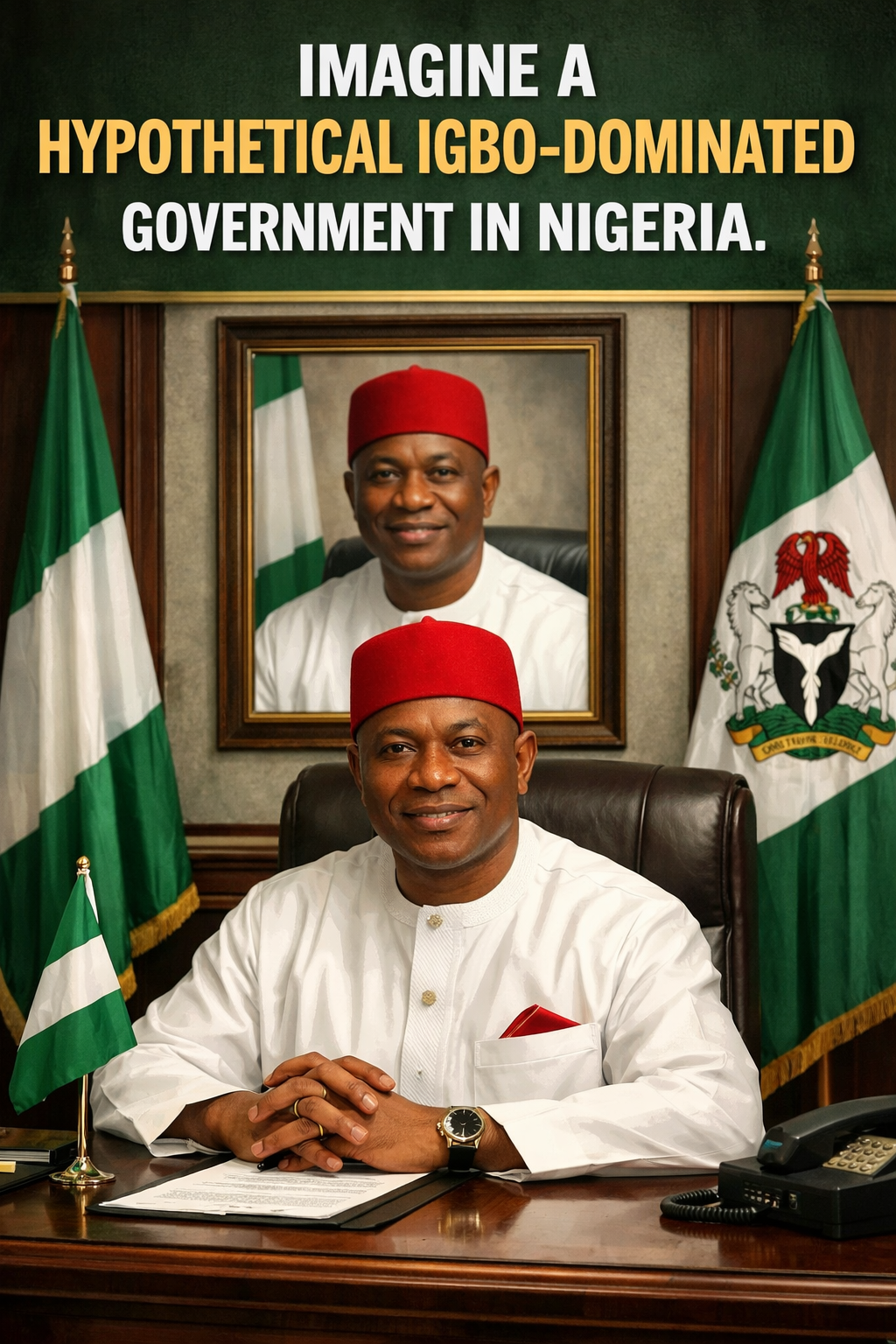
Consider this situation: an Igbo individual ascends to the highest office in Nigeria. Picture a government that embodies the leadership approaches of Muhammadu Buhari or Bola Ahmed Tinubu, where every significant role is occupied by members of the same ethnic group:
– President of Nigeria – Igbo
– Chief Justice of Nigeria – Igbo
– EFCC Chairman – Igbo
– DSS Director-General – Igbo
– IGP of Police – Igbo
– Attorney General – Igbo
– Finance Minister – Igbo
– Accountant General of the Federation – Igbo
– Auditor General of the Federation – Igbo
– NNPC GMD – Igbo
– NAFDAC DG – Igbo
– Chief of Army Staff – Igbo
– CBN Governor – Igbo
– FIRS Chairman – Igbo
– INEC Chairman – Igbo
– Comptroller-General of Immigration – Igbo
– NPA Managing Director – Igbo
Let us be candid with ourselves. Nigeria would descend into chaos. The environment would be rife with resentment, prime-time news would be saturated with debates, urgent town hall gatherings would emerge, and sermons would resonate with cries of “marginalisation.” Hashtags would spark movements. Analysts would forecast national fragmentation. Political figures would threaten constitutional crises. And keep in mind: even if every appointee were the most qualified, the most competent, and the most incorruptible Nigerian available, the backlash would still be intense.
However, the same individuals who supported Buhari’s biased appointments, along with those who now endorse Tinubu’s favouritism under the guise of “merit,” would abruptly begin to advocate for the federal character principle. The very people who once proclaimed “competence over tribe” would start to whisper about “balance for stability.” The fervent advocates of centralised power would unexpectedly emerge as champions of inclusion. The stark truth is that many of us, including my own community, the Ndigbo, would lose our composure. This would not be due to a sudden unfairness in the system, but rather because, for the first time, the goat would not be grazing in our own yard.
This exemplifies the hypocrisy of Nigeria, laid bare for all to witness, much like a yam resting in the market square. We conveniently ignore oppression when it serves our interests. We justify exclusion when it benefits us financially. We even sanctify injustice when it aligns with our desires. Yet, the moment the situation shifts along ethnic lines, we brandish the Constitution and recite it as if it were a holy scripture.
This issue transcends any single individual or tribe. It pertains to our collective dishonesty, the type that permits one to exclaim “thief!” upon witnessing another’s hand in the cookie jar, while their own arm is buried deep within. If we are quick to voice our grievances under a hypothetical Igbo-led administration, we must contemplate our silence, our awareness, or even our applause under any other biased arrangement.
Justice is not genuine justice if it solely safeguards our interests. Equity cannot be considered authentic equity if we are the only beneficiaries. Federal character is not merely an attractive term in our Constitution; it represents the essence of our federation. Nigeria cannot prosper through selective indignation. If balance is essential, it must be upheld consistently. If merit is significant, it ought to apply to all. If national unity holds value, it cannot merely be a transient visitor that appears when it is advantageous.
The pertinent question is not, “What if an Igbo president acted in this manner?” The crucial inquiry is: Are we truly dedicated to fairness, or merely to the advantages of authority? When the circumstances shift, will we continue to respond in the same manner? Or will we ultimately recognise that our belief was never in the rhythm, but solely in who was directing the ensemble?
When we consider a hypothetical government led by an Igbo president in Nigeria, we are faced with the disquieting reality of our selective outrage and hypocrisy concerning equity and justice. This situation urges us to scrutinise our dedication to fairness and inclusivity, prompting us to ponder whether our values remain steadfast regardless of who holds power, or if they simply function as convenient rhetoric when circumstances change.
NzeIkayMedia ✍️
Disclaimer:
All sketches, images, pictures, and videos featured are sourced from the public domain.