

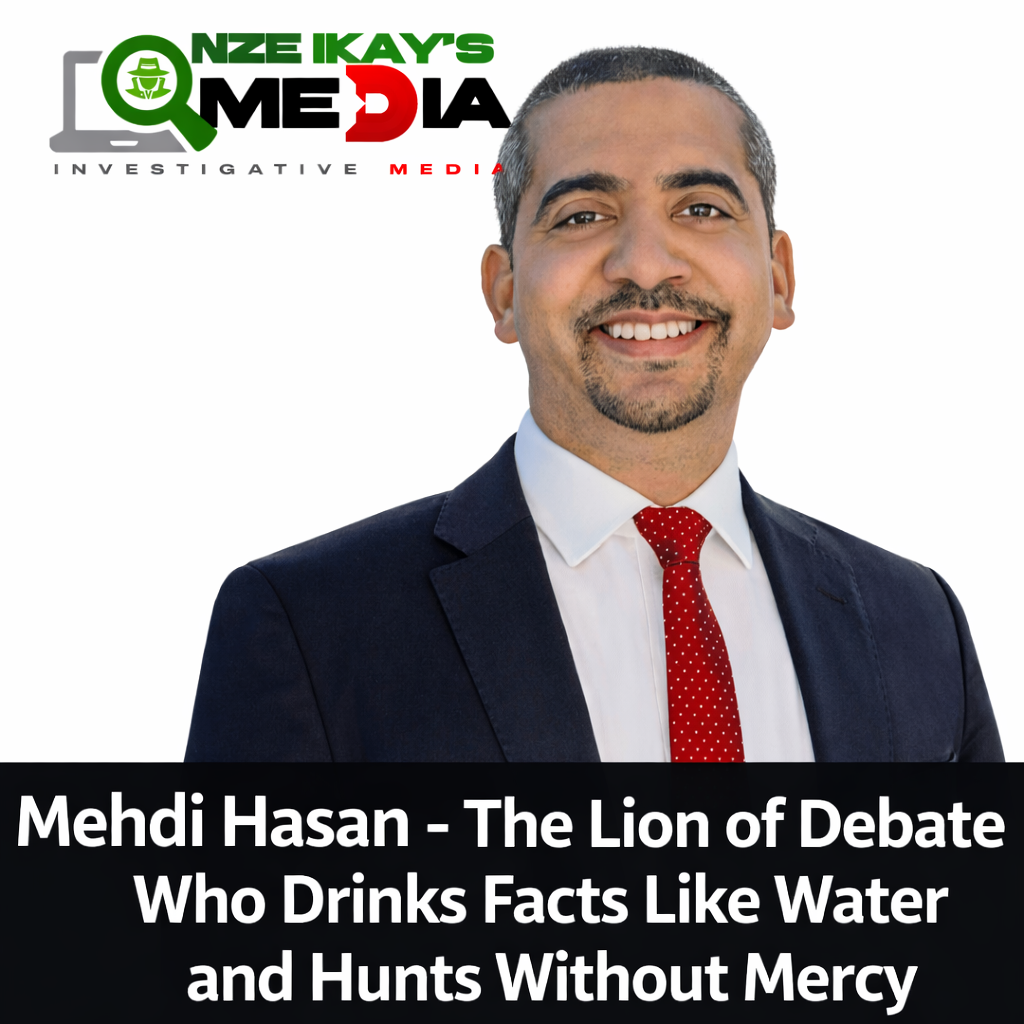
In the vast savannah of global journalism, where many jackals scavenge for scraps of ratings and others merely graze on the grass of press releases, there emerges occasionally a lion, a figure whose roar commands attention and whose hunt is a thing of beauty to behold. Mehdi Hasan is precisely such a lion. For those who have followed his tracks from the banks of the Thames to the Potomac River, his rise from the tall grasses of British political journalism to becoming one of the most formidable interviewers of our time reads like a classic African folktale, the story of the tortoise who, through sheer cunning and preparation, outruns the hare time and time again. Until two days ago, when he mesmerised Daniel Bwala on his show Head to Head, many Nigerians and Africans had no idea the kind of gold they were leaving by the riverside. As the Yoruba saying goes, “The one who does not know where the rain began to beat cannot know where it dried.” To understand why Hasan’s encounter with Bwala was like watching a master drummer teach apprentices, one must understand the journey that forged this extraordinary craftsman.
Every great iroko tree begins as a tiny seed buried in the soil. Mehdi Raza Hasan, born in Swindon, England, in July 1979 to Shia Muslim parents who had migrated from Hyderabad, India, was that seed planted in fertile ground. Like the son of a village chief sent to learn the ways of the white man, Hasan was privately educated at Merchant Taylors’ School before proceeding to Christ Church, Oxford, where he studied Philosophy, Politics, and Economics, the famous PPE that has produced more than its fair share of lions and, occasionally, hyenas. There is an African proverb that says, “The child who is not embraced by the village will burn it down to feel its warmth.” Oxford embraced Hasan, but more importantly, it gave him the tools to question, to dissect, and to rebuild. When he graduated in 2000, his classmates scattered into management consulting and investment banking, the well-trodden paths to wealth. But Hasan, to the great disappointment of his immigrant parents who had crossed oceans dreaming of doctor sons and lawyer sons, chose the path of thorns: journalism.
He began as a researcher and producer on ITV’s Jonathan Dimbleby programme, learning the craft like an apprentice goldsmith learning to handle fire without getting burned. He worked on the BBC’s The Politics Show, became deputy executive producer on Sky’s breakfast show Sunrise, and eventually moved to Channel 4 as editor of news and current affairs. Each role was like a new forge, tempering the blade that would later cut through the toughest political armour. In 2012, Hasan joined Al Jazeera English as a presenter. For those who understand the media landscape, this was like a master fisherman being given a larger canoe and stronger nets. Al Jazeera, with its global reach and willingness to ask the questions others feared to utter, provided Hasan with the platform his talents deserved. It was at the Oxford Union in 2013 that the world first truly saw the lion’s teeth. Debating whether Islam is a peaceful religion, Hasan stood before a hall full of sceptics and, like David facing Goliath, armed himself not with stones but with facts, logic, and the kind of rhetorical precision that leaves opponents wondering what hit them. The motion passed with 286 votes in favour, 168 against. Hasan had won, and the journalism world took notice.
“A hunter does not boast of his skill until the game is caught and tied,” goes the saying. Hasan was catching the game, and he was tying it well. His show, Head to Head on Al Jazeera, became required viewing for anyone who believed that an interview should be more than a glorified press release. He treated his guests the way a village elder treats a wayward youth, with respect, but with the expectation that they would account for their actions. In 2015, Hasan moved to Washington, D.C., to work full-time for Al Jazeera on UpFront. When he arrived, people told him he would end up at CNN or MSNBC. He laughed. “No one’s ever going to hire me,” he thought. “I’m a brown, Muslim, lefty immigrant. I’m happy at Al Jazeera”. This humility, this understanding of his place in the American media landscape, is reminiscent of the African proverb: “However tall the iroko tree grows, it never forgets that its roots are in the earth.” Hasan never forgot his roots, even as he began to grow taller than the trees around him.
In 2018, he launched the Deconstructed podcast for The Intercept, featuring guests like Noam Chomsky, Ilhan Omar, and Bernie Sanders. The podcast was like the village drum, gathering people around to hear the news interpreted with wisdom and courage. Then came 2020. NBC’s new streaming service, Peacock, offered him his own show, The Mehdi Hasan Show, which began airing in October of that year. By February 2021, MSNBC added the show to its Sunday lineup. The immigrant boy from Swindon, the son of Hyderabadi parents, was now a fixture on American cable news. There is a saying among the Akan people: “Only when you have crossed the river can you say the crocodile has a lump on its snout.” Hasan had crossed the Atlantic, and now he could see the American media landscape for what it was: a place where crocodiles swam freely, and where most journalists were content to float peacefully downstream rather than swim against the current.
What sets Hasan apart from the multitude of talking heads that populate our screens? The answer lies in a Fula proverb: “However long the log lies in the river, it will never become a crocodile.” Many journalists spend decades in the profession without ever developing teeth. Hasan arrived with teeth fully formed. His preparation is legendary. When he interviews someone, he does not come with a list of softballs designed to extract pre-rehearsed talking points. He comes with the kind of forensic detail that would make a coroner proud. He drinks facts like water, not sip by sip, but in great, quenching gulps that satisfy the thirst for truth. When John Bolton, the former National Security Adviser under Trump, sat across from Hasan, it was not an interview; it was an encounter. Bolton, a man who had advised the most powerful nation on earth, found himself having to defend his positions against a journalist who had done his homework better than most graduate students. Jen Psaki, President Biden’s press secretary, later admitted that of all her White House interviews, Hasan’s was the most difficult. This is the mark of a true master: when your opponents respect you not because they like you, but because they know you will come prepared. As the Igbo say, “A man who does not know where the rain began to beat him cannot say where he dried his body.” Hasan’s opponents always know exactly where the rain began to beat them.
In journalism, as in life, the path of courage is rarely the path of comfort. When the Israel-Hamas war erupted in 2023, Hasan did what he has always done: he asked hard questions, he sought truth, and he refused to be silenced by the comfortable consensus. MSNBC cancelled his show, along with those of two other Muslim commentators, Ayman Mohyeldin and Ali Velshi. The network claimed the shifts were coincidental, but the journalism community and the public were not fooled. “When you see a bearded man in your dream, and you wake up and see a goat,” goes the Ethiopian proverb, “don’t say it was just a dream.” The symbolism was clear, and the message was received. Hasan announced his departure from MSNBC on January 7, 2024, in his final broadcast. But as the Yoruba say, “The elephant that steps on a trap does not die, it breaks the trap and moves on.” Hasan was not dying; he was being liberated.
Zeteo: The Hunter Becomes His Own Master – After leaving MSNBC, Hasan did what only the bravest and most respected journalists dare to do: he started his own media company. Zeteo, from the ancient Greek word meaning “to seek out, to inquire, to get to the truth”, launched in February 2024. The name itself is a mission statement. Hasan was not content to be a voice within someone else’s choir; he wanted to build his own cathedral. Within a year, Zeteo had 400,000 subscribers, 40,000 paying members, and 715,000 YouTube followers. The platform turned a small profit in its first year, something most startups cannot claim. “The lizard that jumps from the high iroko tree to the ground,” says the proverb, “does so with its eyes open, knowing it will land on its feet.” Hasan landed on his feet. His contributors now include Taylor Lorenz, Naomi Klein, Bassem Youssef, Owen Jones, and even Greta Thunberg. The village he built attracts people from far and wide.
Hasan’s philosophy of journalism is simple and uncompromising. He rejects the false dichotomy between activism and journalism. “You don’t have to define activism as changing things and journalism as not changing things,” he says. “The biggest changes in our society have come from journalism. Investigative journalism, at its very best, changes things. It holds people accountable. It forces people to change structures, reform institutions”. This is the kind of talk that makes establishment media uncomfortable. They prefer journalists who keep their heads down, who play the game, who understand that access is more important than truth. Hasan keeps his head up. He always has. “When the mouse laughs at the cat,” goes the Swahili proverb, “there is a hole nearby.” Hasan has always had his hole, his preparation, his facts, his unwavering commitment to truth. From that position of strength, he can laugh at the cats who would prefer he stay silent.
In 2023, Hasan published Win Every Argument: The Art of Debating, Persuading, and Public Speaking. The book is not just a manual; it is a manifesto. It distils decades of experience into principles that any truth-seeker can apply. But Hasan is also wise enough to know when not to debate. In 2023, he warned that “there are certain people who there is no point arguing with,” specifically those who operate in bad faith. This wisdom, knowing when to engage and when to walk away, is the mark of a true elder. As the Akan say, “The fool speaks, the wise man listens.” Hasan listens to his instincts, and they rarely lead him astray. Yet even Hasan sometimes finds himself in situations that test his principles. In 2025, he appeared on Jubilee Media’s Surrounded series, debating 20 far-right conservatives. The experience disturbed him. “The people here today were way beyond conservative,” he said. “This is open authoritarianism, and this is what is being normalised and mainstreamed in our country”. The episode went viral, with over 3.5 million views, proving that even when Hasan is uncomfortable, he is compelling. “Even a goat that is about to be slaughtered,” says the proverb, “does not lose the will to bleat.” Hasan will bleat his truth until his last breath.
The African and Nigerian Connection. This brings us back to the moment that inspired this reflection: Hasan’s encounter with Daniel Bwala on Head to Head. For many Nigerians and Africans, this was their introduction to a man who has been dominating global journalism for over a decade. As the Hausa say, “The one who arrives early at the pond drinks clean water; the one who comes late drinks muddy water.” Africans have been drinking muddy water, missing Hasan’s shows because they simply did not know where to look. But now the word is out. Hasan’s style, direct, confrontational, deeply researched, resonates with an African audience that has long been fed a diet of soft journalism and political propaganda. In a continent where leaders often go unchallenged and where the media frequently serves as a government megaphone, Hasan represents something refreshing: the journalist as equal, as interrogator, as the people’s advocate. His interview with Bwala was not just an interview; it was a masterclass. Watching him work is like watching a master weaver at the loom, every thread placed with intention, every question building on the last, until the final pattern emerges in all its complexity. “A cow that has no tail,” goes the Igbo proverb, “should not chase flies.” Hasan has a tail, and he uses it with devastating effect. His guests cannot chase away the flies of their own inconsistencies because Hasan pins them down with facts.
Who is Mehdi Hasan when the cameras stop rolling? He is a father, a husband, a man who worried about starting a business during Ramadan while fasting. He is cautious by nature, lacking the entrepreneurial bravado of media moguls who treat journalism as just another business. He is, by his own admission, surprised by his success. “I didn’t think I’d last longer than six months” at MSNBC, he says. He lasted 3½ years. He is also a man who has evolved. In his youth, he held views on abortion and homosexuality that he now regrets. He has publicly disavowed those positions, demonstrating a capacity for growth that is rare in public figures. “The river that forgets its source,” says the proverb, “will eventually dry up.” Hasan has not forgotten his source, but he has allowed the river of his thought to flow into new channels.
In today’s America, being Mehdi Hasan is not without risk. Prominent figures in the MAGA movement have called for his deportation, for his denaturalisation. In a country where journalists are increasingly intimidated, threatened, and harassed, Hasan continues to speak. But he is also a man of perspective. When asked about the risks he faces, he points to Gaza, where over 200 journalists have been killed in the current conflict. “The Civil War, WWI, WWII, none of it comes close,” he says. “Yes, it’s a risky time for journalists in America, but in context, we’re still 10,000 times in a better place than journalists in Gaza”. This humility, this ability to see his own struggles in the context of greater suffering, is what elevates Hasan from mere journalist to something approaching a public intellectual. “The drum does not beat itself,” says the proverb, “and the dancer does not dance alone.” Hasan understands that he is part of a larger struggle, a global fight for truth and accountability.
The Lion’s Roar Continues. Mehdi Hasan’s journey from Swindon to Washington, from researcher to founder, is a testament to what journalism can be when it is practised with courage, preparation, and an unwavering commitment to truth. He has grown from obscurity to become a trailblazer not by following the herd, but by leading it. For young journalists in Nigeria, in Africa, and around the world, Hasan offers a model. Not the model of the journalist as celebrity, dining with the powerful and trading access for soft treatment. But the journalist as truth-seeker, as advocate for the voiceless, as the one who drinks facts like water and hunts falsehood without mercy. “A man who uses feathers to climb a tree,” says the proverb, “cannot complain when he falls.” Hasan has built his career on rock, not feathers. His foundation is preparation, his structure is integrity, and his roof is the courage to speak truth to power.
When he sat across from Daniel Bwala few days ago, he was not just conducting an interview. He was demonstrating, for all who had eyes to see, what journalism looks like when it is done right. For Nigerians and Africans who had never watched him before, the revelation was like the rising of the sun after a long night. As for Hasan himself, he continues to climb. Zeteo grows. His audience expands. His voice carries further with each passing year. The lion of debate, who drinks facts like water and hunts without mercy, is still roaring. And the wise will continue to listen. “However long the night,” concludes the Ghanaian proverb, “the dawn will break.” For Mehdi Hasan, the dawn has broken, and the light reveals a journalist for the ages, a man who reminds us that in a world of spin, propaganda, and comfortable lies, the truth still has a champion.
NzeIkayMedia ✍️
Disclaimer:
The sketches, images, pictures and videos are obtained from the public domain.