


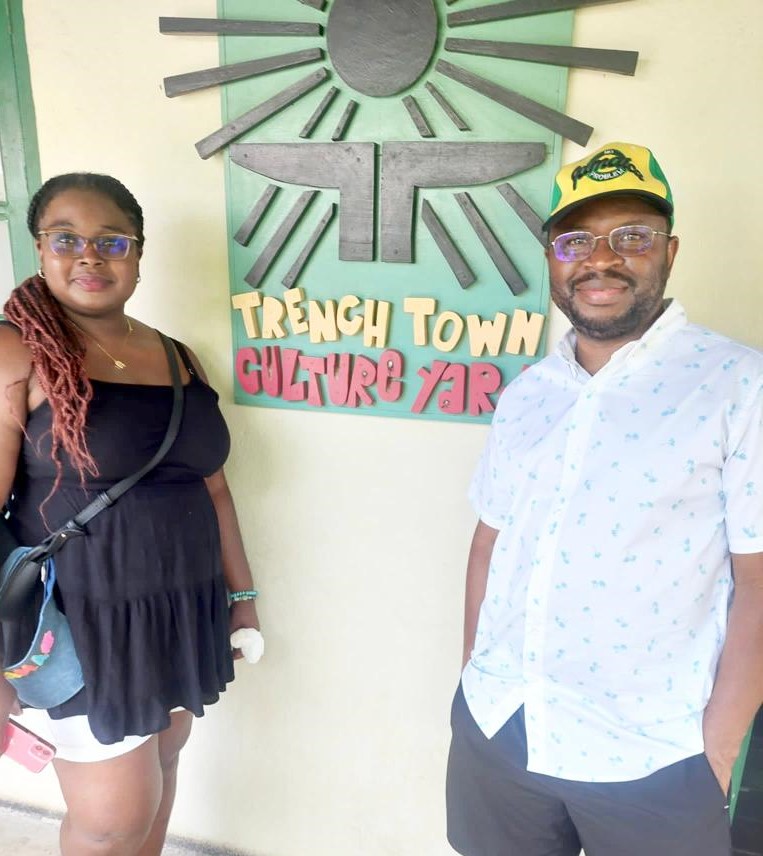
My wife and I vacationed in Jamaica for a week a few weeks ago both to decompress from our busy lives here in the United States and to explore and soak in the gorgeous, pristine beaches and rich, riveting history of Jamaica, the island nation of fewer than 3 million people, which nonetheless has an outsized global cultural influence that belies its modest size and population. When we landed in Kingston, the Jamaican capital, it felt like I was in Nigeria, which I haven’t visited since June 2016. This brisk, bustling city’s sights, sounds, and smells struck me as distinctly West African, even Nigerian. Everywhere I turned, I saw people who reminded me of the family members, friends, and acquaintances I left in Nigeria.
I shouldn’t be surprised because it’s common knowledge that a little over 90 percent of Jamaicans trace ancestral provenance to West Africa. The ancestors of most modern Jamaicans were enslaved to the Americas mostly from the Akan and Ashanti people in Ghana and from the Yoruba, Igbo, and Ibibio people of Nigeria. But it’s still astonishing how remarkably West African these people still are after hundreds of years of separation from their origins.
Kingston looks and feels like the stereotypical African city. The hustle and bustle of the city, the open markets, the street food, the ever-present, often needless, honks from the horns of motorists, the haggling over prices of most things, the uneasy co-mixing of spotless prosperity and grubby poverty, etc. remind you of a typical city in West Africa even though Jamaica is just a two-hour flight from Atlanta in the United States. We went there as tourists, but we were indistinguishable from the locals—until we spoke, that is. I had never felt more at home in a foreign country than I did in Jamaica. It wasn’t only redolent of home, that is, Nigeria, it felt truly like home. Even the flora and fauna of the country evoked memories of my growing up in Nigeria because Jamaica is in the tropics. I saw weeds, grass, flowers, and fruits that I grew up with in my hometown whose names I don’t know in English and that I have never seen in the United States. In some parts of the country, we encountered savannah vegetation. In other parts, we saw rainforest vegetation—like you would in many West African countries. This redounded to the sensation of familiarity we felt throughout our stay there.
Afrocentrism is mainstream here. So are Rastafarianism and belief in African spirituality even for people who profess Christianity. For instance, Obiism, which we call juju or jazz in Nigeria, is rife not just in Jamaica but in the entire Caribbean islands. Juju men or medicine men are called “Obeah men.” Scholars have traced the etymology of Obeah to dibia, the Igbo term for medicine man. Skin bleaching is negligible. Race pride is sky-high. People here embrace their Africanness with fierce pride. When people discovered we were Nigerians their attitudes changed toward us: they became exceptionally friendly and protective without expectation of reward. For example, when we visited the Trench Town Culture Yard Museum, a Kingston neighbourhood where Bob Marley grew up and which has the distinction of being the birthplace of reggae music, the head of the place called my wife and I “queen and king” because we said we were from Nigeria.
She was sitting comfortably in her easy chair when we were ushered into her office. She probably first assumed that we were Black Americans. The moment we said we were from Nigeria, she instinctively got off her seat in a show of reverence that both discomfited and surprised me. She said we were their brother and sister from the motherland, “our queen and our king.” It later occurred to me that it wasn’t us as Maureen and Farooq that she was in awe of; it was what we represented to her. We symbolized her West African ancestors. She wasn’t alone. Everyone in Trench Town, from the tour guide to random people in the streets who recognized us as Nigerians, treated us with noteworthy kindness and fraternal love. One man whom our tour guide told we were from Nigeria gave us his umbrella for free because it was drizzling as we walked toward a part of the town Bob Marley memorably described as a “concrete jungle” in one of his songs. When I asked how he would get his umbrella back, he said we could take it with us. He was overcome with emotions that we were Nigerians who came to visit Jamaica and connect with our long-lost cousins. It almost made me shed a tear. We gave the umbrella back to the tour guide to return it to him.
It was an inexplicably surreal sensation when we walked the streets that Bob Marley walked as a child and sat on the bed he slept in for years after he left his mother in Delaware in the United States and returned to Jamaica. The room, which is just a few meters away from his guardian’s room in a multi-family, tree-studded compound that is reminiscent of a traditional West African home, inspired the famous “Three Little Birds” song. The dingy little room is located in a part of the compound that causes, even forces, you to rise up in the morning “with the risin’ sun.” And the verdant, arboreal abundance of the compound invited, still invites, birds to perch on trees and descend on the ground to sing sweet songs. That was the sentiment Marley captured when he sang, “Three little birds/Pitch by my doorstep/Singin’ sweet songs/Of melodies pure and true.” Our visit to the home Bob Marley built and lived in on 56 Hope Road in Kingston until his death (which has been converted to the Bob Marley Museum) was no less thrilling. In his bedroom, Marley created a special space for gifts he got from different parts of Africa, which are still carefully preserved.
A major highlight of the tour of the Bob Marley Museum was an interaction with the warm, avuncular, and pleasant Bongo Herman, Bob Marley’s percussionist and contemporary. Herman, who is 79 and was born Herman Davis, spotted me in the crowd of tourists and motioned me to come. He asked if I was African. I answered in the affirmative and added that I was Nigerian. He said he suspected I was Nigerian but didn’t want to be wrong by being too specific. It turned out that he had visited Nigeria—and several African countries—many times and collaborated with scores of African, including Nigerian, musicians. I would also mistake him for a Nigerian if I met him anywhere. He looks every bit like an Igbo man from Umuahia! We also spent some time in Montego Bay, Jamaica’s commercial nerve centre. It’s saner, gentler, wealthier, and more beautiful than Kingston. Its serenity and marble splendour remind me of Abuja.
But in spite of its many similarities with Nigeria, Jamaica bests Nigeria in the human development index. It’s a higher-middle-income country. Nigeria is a lower-middle-income country. The Jamaican dollar is way more robust than the Naira. And Jamaica’s infrastructure is more virile than Nigeria’s. Electricity is constant in the cities we visited. Only natural disasters cause power outages, locals told us. Unlike Nigeria, Jamaica has no natural resources. Tourism is its major source of revenue. Nonetheless, Nigeria’s influence is growing in this island nation. Afrobeats are everywhere and are threatening to upend reggae. Early this year, Jamaican Opposition Leader Mark Golding lamented that “Afrobeats is eating our food,” which is a reference to the progressively diminishing influence of Jamaican music as a direct consequence of the rise of Afrobeats.
In spite of this, everyday folks in Jamaica love Nigeria. For some reason, former President Goodluck Jonathan is hugely popular here. Most Jamaicans who discovered we were Nigerians never failed to ask after Goodluck Jonathan. It was in Montego Bay that a taxi driver told us that Jamaicans love Jonathan because when he visited the country, he offered to sell petrol to the country at cheaper prices than they get from Venezuela but their leaders spurned the offer. They also said he kept his promise to enable direct flights from Nigeria to Jamaica. I haven’t confirmed the accuracy of these claims, but Jonathan is by far the most popular Nigerian leader in Jamaica now. You can’t write about Jamaica without talking about Jamaican Patois, which shares historical and linguistic affinities with West African Pidgin English. I thought because I could make sense of written Jamaican Patois based on my knowledge of Nigerian Pidgin English, I wouldn’t have trouble understanding spoken Jamaican Patois. Wrong.
“Good night” means “good evening.” If you understand “good night” to be the conversational expression of goodbye, there will be a communication breakdown, like there was between my wife and our hotel receptionist. And if you don’t understand anything, just say, “Yeah, man!” It’s an all-purpose interjection for almost everything—or so it seems.
Disclaimer:
The opinions and views expressed in this write-up are entirely that of the Writer(s). They do not reflect the opinions and views of the Publisher (Nze Ikay’s Blog) or any of its employees. The designations employed in this publication and the presentation of materials herein do not imply the expression of any opinion whatsoever of the Publisher (Nze Ikay’s Blog) or its employees concerning the legal status of any country, its authority, area or territory or concerning the delimitation of its frontiers. Equally, the sketches, images, pictures and videos are gotten from the public domain.








This website certainly has all of the information and facts I wanted concerning this subject and didn’t know who
to ask.