


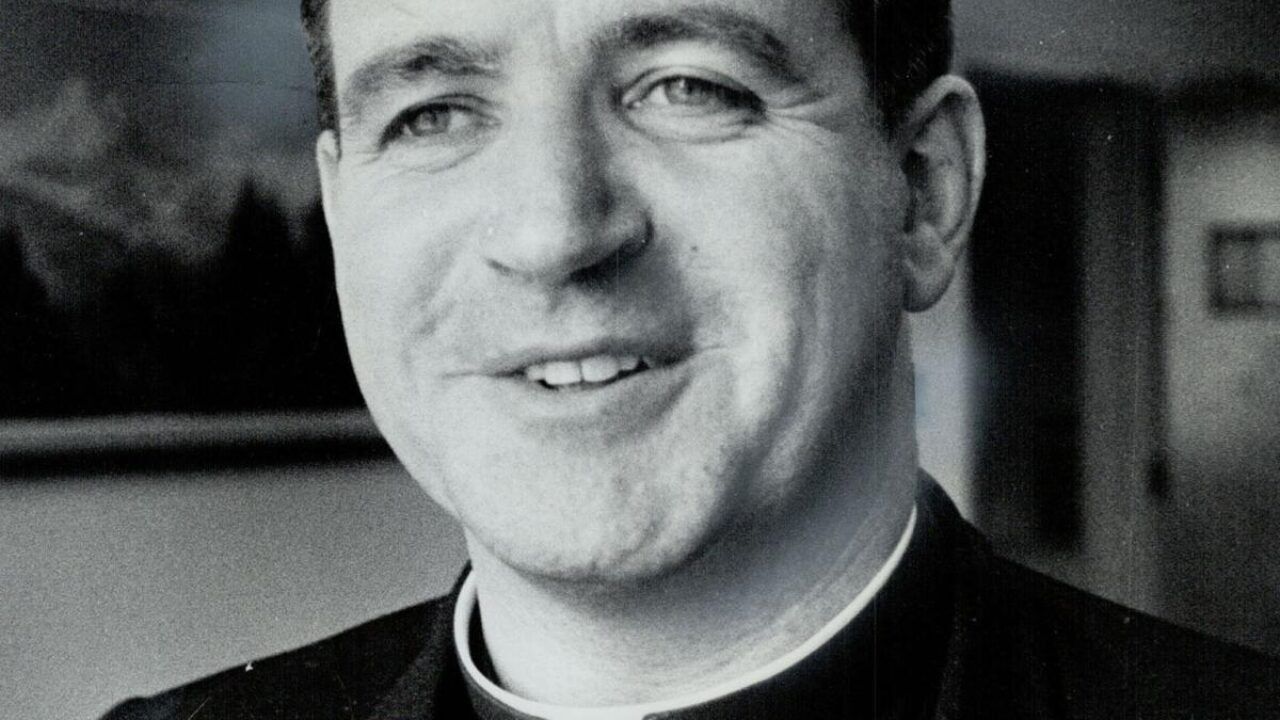
In 1968, Father Doran, who had been in Nigeria as an educator, became the linchpin of one of the largest civilian humanitarian efforts in history. The cargo plane flew in low over southeastern Nigeria, its lights out, its radio off, its pilot navigating by the glow of refinery flares along the coast. The runway, somewhere below, was dark. The pilot dropped his wheels and nosed the plane downward, seemingly into the void. On the ground, a team of boys suddenly ran out of the bush to light rows of kerosene lamps to guide the craft toward the tiny airstrip, just 75 feet wide and 1,200 feet long. Aboard were 26 tons of antibiotics, flour and salted fish, and a 34-year-old Irish priest named Dermot Doran.
It was December 1968, and Nigeria was in the midst of a civil war. After nearly a decade of pogroms against them, the Igbo people of the country’s southeastern states had seceded to form the independent republic of Biafra. The Nigerian Army almost immediately attacked, and it soon had a blockade around the region, leaving 14 million residents to starve.
Father Doran was one of 1,000 priests and nuns, mostly from Ireland, who had been working in the area when the fighting broke out. Overnight, they pivoted from their peacetime roles as educators — Father Doran had been a high school principal — to aid workers during one of the 20th century’s worst humanitarian crises. Overall, the Biafran airlift brought 60,000 tons of aid to the region, at the time the largest mobilization of aid by civilians in history. Between 500,000 and two million noncombatants died because of the blockade — but an estimated one million more survived because of the airlift.
Father Doran was its linchpin. Sneaking in and out of Biafra, he located the first planes and hired the first pilots. He went to New York City to arrange the first aid shipments. He mapped out the logistics of moving thousands of tons of supplies from Europe and North America to airfields in Gabon and Sao Tome, an island south of Nigeria that was then under Portuguese rule. He accompanied many of the flights from there into Biafra, coordinated supply distribution, caught up with locals and other priests, and then left to tell the world what he had learned. He had a way with the news media, befriending, among others, Harry Reasoner of CBS and the BBC correspondent Frederick Forsyth, whose experience in Biafra helped inspire his conversion to write political thrillers. Father Doran testified before the United States Senate, leaving a lasting impression on Senator Edward M. Kennedy, who became a leading advocate for Biafra in Congress. “He never did anything halfway,” Frank Carlin, a retired overseas director for Catholic Relief Services, said in a phone interview. “He was always programming and planning, then he went back and told the story.”
Father Doran died on May 19 in Dublin. He was 88. His niece Cathy Doran said the cause was myelodysplastic syndromes, a rare form of blood cancer. His death, in a hospital, was not widely reported at the time. Father Doran arrived in Nigeria in 1961, not long after being ordained as a member of the Holy Ghost Fathers, a Roman Catholic congregation also known as the Spiritans. The congregation had long had a strong presence in Nigeria, especially in the southeast, where the Igbo population is mostly Christian. He had worked in developing countries before — he spent several years as a teacher in Trinidad — but he fell in love with Nigeria, and especially the Igbo culture, which, with its rich storytelling traditions and its history of intense suffering under English rule, seemed of a piece with the Irish experience.
“I was sent there, and they became my people,” he said in an interview for “Biafra: Forgotten Mission,” a 2018 documentary directed by Brendan Culleton and Irina Maldea. The effects of the blockade were immediate and devastating, especially after Nigeria captured Biafra’s oil-rich coast in early 1968. Residents of Biafra got most of their protein from dried fish; without it, children quickly developed kwashiorkor, a protein deficiency that caused their bellies to swell. At the worst part of the crisis, in late 1968, some 10,000 people a day were dying, according to Red Cross estimates. “It’s something you don’t expect to meet in your life,” Father Doran said in the documentary. Nigeria was supported in the war by Britain, which had once ruled it as a colony, and the two countries tried to maintain a news blackout. But by the end of 1967 Father Doran had made several trips to Lisbon and New York, and he and others managed to smuggle journalists into the region to report on the unfolding crisis.
Biafra became an international rallying cry. Thousands took part in protest marches in London and Paris. In June 1969, a Columbia University student named Bruce Mayrock set himself on fire in front of the United Nations; he died the next day. In Britain, John Lennon returned his M.B.E. medal to Queen Elizabeth II, partly in protest over his country’s role in the blockade. More aid organizations arrived. Roman Catholic, Protestant and Jewish groups, including Catholic Relief Services, gathered under an umbrella effort called Joint Church Aid, which collected supplies for transit through the airlift. Father Doran was its relief organizer. The pilots nicknamed it Jesus Christ Airlines. “It’s a fantastic example of ecumenism,” Father Doran told United Press International in 1969. “We mightn’t be agreed on theology — but we are agreed on bread.”
The Biafran airlift is widely considered a watershed moment in international humanitarianism. It was the first time nonprofits and private citizens led the response to a crisis. Several countries, including the United States and Israel, quietly supported the airlift, but it received no official government approval. In New York, Ireland’s ambassador to the United Nations told Father Doran to stay out of Nigeria’s business. And the world stood by while the Nigerian air force attacked the airlift, bombing the airfield and destroying several planes, killing 25 crew members. In a debate with Father Dermot on the CBS program “The World of Religion,” the Nigerian ambassador to the United Nations, Edwin Ogebe Ogbu, claimed that the airlift was supporting the rebels and, by prolonging the war, driving up the death toll. Father Doran said in response, “If you call innocent children and babies a few days old, and babies a week old or a month old who are dying of starvation — they have no milk, no food — if they are rebels, I don’t know what.”
Michael Dermot Doran was born on Sept. 22, 1934, in Athboy, 35 miles northwest of Dublin. His parents, Thomas and Mary Anne (Guinan) Doran, ran a pub; years later one of Dermot’s brothers, Eamonn, founded one of New York City’s most popular Irish bars. He died in 1997. Along with his niece Cathy Doran, Father Doran is survived by his sister, Mary Mosely; three other nieces, Annemarie Wylie, Jenn Mosely and Rosalynd Mosely; and five nephews, Hans, Dermot, Eddie, Alan and Paul Doran. Father Doran entered the Spiritan novitiate in 1952 and graduated with a degree in philosophy from University College Dublin in 1955. He spent three years as a prefect at St. Mary’s College in Port of Spain, Trinidad, before returning to Ireland to complete his religious studies. He was ordained in 1961.
The Biafran war ended in 1970 when Nigeria reconquered the breakaway region and expelled most of the European missionaries. Father Doran was then assigned to work as a communications officer with Catholic Relief Services in New York, from which he was dispatched to disaster zones worldwide. In the early 1970s, when he was sent to Bangladesh and India, he became close with Mother Teresa, who invited him to deliver mass to her sisters in Calcutta (now Kolkata). In 1975 he moved to Toronto, where he became director of Volunteer International Christian Service, another aid organization. He also served as the director of Brottier Refugee Services, a resettlement agency, before retiring in Ireland in 2008. “Dermot was everywhere,” Mr Carlin of Catholic Relief Services said. “He got more out of a day than anyone I knew.”
Clay Risen is an obituaries reporter for The Times. Previously, he was a senior editor on the Politics desk and a deputy op-ed editor on the Opinion desk. He is the author, most recently, of “American Rye: A Guide to the Nation’s Original Spirit.”
Disclaimer:
The opinions and views expressed in this write-up are entirely that of the Writer(s). They do not reflect the opinions and views of the Publisher (Nze Ikay’s Blog) or any of its employees. The designations employed in this publication and the presentation of materials herein do not imply the expression of any opinion whatsoever of the Publisher (Nze Ikay’s Blog) or its employees concerning the legal status of any country, its authority, area or territory or concerning the delimitation of its frontiers. Equally, the sketches, images, pictures and videos are gotten from the public domain.



My brother recommended I might like this web site. He was entirely right.
This post truly made my day. You can not imagine simply
how much time I had spent for this information! Thanks!
Having read this I believed it was very informative.
I appreciate you finding the time and effort to put this article together.
I once again find myself personally spending a significant amount of time both reading and posting comments.
But so what, it was still worth it!